A warm cookie can fall apart between the baking sheet and the cooling rack. The right spatula helps prevent that disappointment. A Silicone Cookie Spatula combines a flexible edge with a surface that is generally gentle on nonstick bakeware. Small details matter. A thin edge slides beneath delicate cookies, while a supportive core helps carry heavier chocolate-chip rounds without excessive bending.
Pastry chef and baking author Stella Parks has explained that cookies continue cooking on the hot baking sheet after leaving the oven. That observation matters when choosing both your timing and your tools. Fresh cookies need time to develop enough structure for lifting. Even a well-designed spatula cannot rescue every cookie moved too early. Let them settle. Then ease the blade beneath one cookie and check whether its center holds together before transferring the rest.
Choosing a Silicone Cookie Spatula also means looking beyond its color or advertised flexibility. Check the manufacturer’s temperature rating, care instructions, and suitability for contact with food. A seamless design can reduce crevices where butter and crumbs collect. Blade thickness deserves attention, too. Some silicone edges are too bulky for thin, crisp cookies, and very soft heads may sag under oversized portions. There is a trade-off. Silicone can be useful for protecting coated pans, but its performance depends on construction and technique. The following guide explores those details so you can choose a spatula that suits your cookies, bakeware, and everyday baking habits.
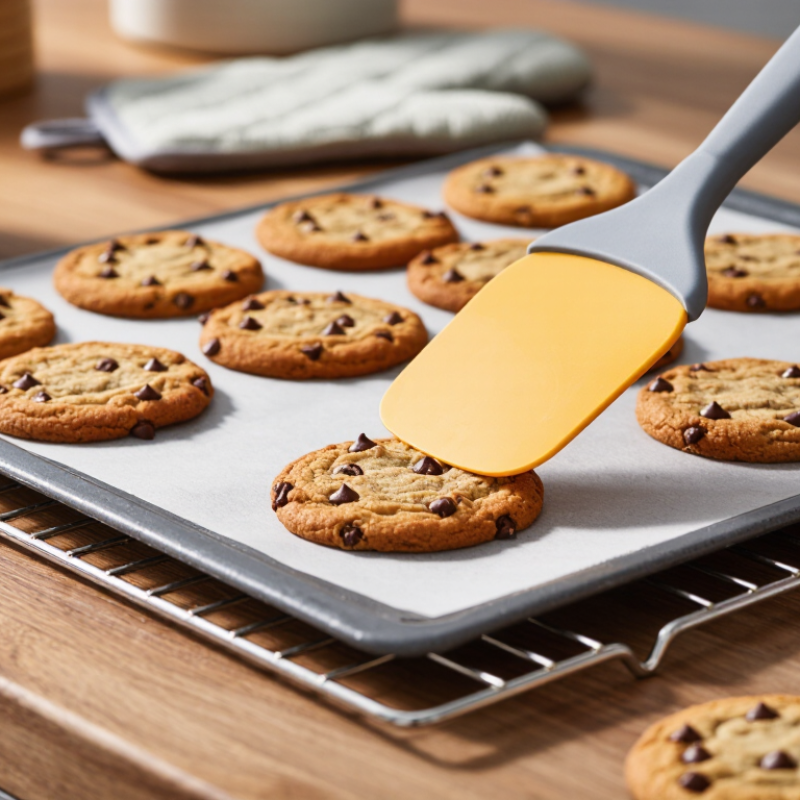
A silicone cookie spatula is a small lifting tool with a flat silicone head, often reinforced with a rigid core. Its thin edge slides beneath baked cookies, while its broad surface supports their centers during transfer. Unlike a curved bowl scraper, it is designed mainly for lifting and serving.
Shape matters.
A narrow head helps you move between closely spaced cookies without nudging their neighbors. Silicone also offers a gentle contact surface for nonstick baking trays, although exposed metal edges can still scratch coatings.
After baking, let cookies rest on the tray until their edges hold together when gently nudged. This may take several minutes, depending on their size and recipe.
Slide the spatula horizontally beneath each cookie, then lift it onto a cooling rack. Move slowly. Warm chocolate chunks can smear, and soft centers may sag beyond a head that is too narrow.
If a cookie wrinkles during lifting, leave the others a little longer before trying again.
The tradeoff is flexibility: a very soft head can bend under thick cookies or heavy cookie bars. Some cookies will still break; choosing silicone does not remove the need to judge their firmness.
A silicone cookie spatula bends slightly as you slide it beneath a cookie, helping support soft, delicate edges. That flexibility is useful when lifting thin sugar cookies or transferring warm oatmeal cookies onto a cooling rack. Thickness matters. A very soft head can fold under a large cookie, especially one loaded with chocolate chunks. Look for a thin leading edge and a firmer center if you regularly bake heavier cookies.
Silicone tolerates heat, but the finished spatula’s temperature limit depends on its construction and materials. Check the manufacturer’s stated rating rather than assuming every silicone utensil handles the same temperatures. Brief contact with a hot baking sheet differs from leaving the spatula resting against it. Handles, internal supports, and bonded joints may have different heat limits. Stay nearby. A heat-resistant head does not make the entire utensil suitable for prolonged oven exposure.
The soft surface also helps protect nonstick baking sheets from scratches during ordinary lifting and scraping. However, trapped sugar crystals or baked-on crumbs can still drag across a coating, so keep the edge clean. One limitation deserves attention: a thick silicone edge may push a fragile cookie instead of sliding underneath it. Letting cookies firm up briefly on the tray can help, although waiting too long may increase sticking. A seamless design also leaves fewer joints where butter and dough can collect during cleanup.
Choose a silicone cookie spatula when protecting a nonstick baking sheet matters more than scraping power. Its soft edge helps reduce scratching, especially when sliding beneath cookies with melted chocolate around their edges.
Check the edge. A thin silicone lip works better than a thick, rounded one for lifting cookies cleanly.
Silicone also suits sticky dough, though it is not completely nonstick; warm caramel can still cling to it.
Metal makes more sense when thinness and rigidity matter, particularly on uncoated baking sheets. A thin metal blade can slip beneath crisp cookies that a bulky silicone head might push or crumble.
For large, soft cookies, choose silicone with a reinforced core and a broad head to limit bending.
Let them set. Even a well-shaped spatula can tear cookies lifted directly from the oven. A few minutes on the sheet often helps, although timing depends on the recipe and cookie thickness.
Wood works well for mixing dough, but its thicker edge usually makes transferring delicate cookies awkward.
Choose silicone when you want one utensil for folding dough and lifting cooled cookies from a coated tray. That convenience involves a compromise: a flexible head may struggle with heavy, oversized cookies.
Check the manufacturer’s temperature rating, and keep the spatula away from direct heating elements.
Wash around seams carefully, where butter and crumbs can collect, and replace heads that split or expose their inner core.
A silicone cookie spatula can help lift cookies while reducing scratches on delicate baking surfaces. Blade shape matters most when cookies are warm and fragile. Choose a thin, tapered edge that slides beneath browned bottoms without pushing them sideways. Rounded corners are useful on crowded trays, where sharp corners might catch neighboring cookies. Check the edge. A thick silicone lip can struggle beneath thin, crisp cookies, even when the material feels pleasantly flexible.
Match the blade width to the cookies you bake most often. For cookies measuring three inches across, a blade around three inches wide provides useful support. Smaller blades fit between tightly spaced portions but leave large cookies hanging over the sides. That overhang can encourage warm centers to bend or crack during transfer. Bigger has drawbacks. An oversized blade can bump nearby cookies or feel awkward inside a small baking tray. Some flexibility helps, but a very floppy blade may sag under a thick oatmeal cookie.
Choose a handle that stays secure in your hand without forcing a tight grip. A slightly oval shape can resist twisting when you lift an unevenly loaded blade. Check where the handle meets the head; deep seams can trap butter and crumbs. A seamless design makes that area easier to clean. A longer handle offers extra reach, though it may reduce control on a crowded tray. Check the stated temperature limit, and avoid resting the spatula against hot oven surfaces.
A flexible silicone blade can help slide beneath cookies and scrape mixing bowls. Choose the blade shape, width, and handle together: a thin, flat edge helps lift cookies, while a curved edge is useful for scraping batter.
How to choose: Compare blade width with the size of your cookies and the space between them. A narrower blade is easier to position in tight spaces; a wider blade supports more of a cookie’s underside. Look for a comfortable handle and enough blade support to lift cookies without excessive bending. Check the utensil’s stated temperature limit before using it with hot bakeware.
The chart shows example dimensions for comparison, not measured product data or recommended size categories. Conversions are exact: 1 inch = 2.54 centimeters. Source: NIST Guide to the SI, Appendix B.8.
A silicone cookie spatula slides beneath delicate edges while helping protect nonstick baking sheets from scratches. Choose a thin, flexible edge with enough support to carry a warm cookie. Check the manufacturer’s temperature limit before touching hot trays. Heat resistance varies. Let cookies rest on the baking sheet until their edges hold together, usually a few minutes. Slide the spatula flat beneath each cookie, then transfer it to a cooling rack. If the center buckles, give the remaining cookies another minute. An extra-wide spatula can feel awkward around tightly spaced cookies.
Wash the spatula with warm water, dish soap, and a soft sponge after each baking session. Focus on the joint where the silicone head meets the handle. Butter and crumbs can collect there, especially on removable heads. If the head detaches as designed, remove it for cleaning. For stubborn residue, soak briefly in warm, soapy water before wiping. Avoid abrasive pads. Use a dishwasher only when the care instructions allow it, and inspect seams afterward.
Dry every part completely before reassembling or storing the spatula. A towel may miss water trapped inside a hollow head, so allow additional air-drying time. Store it flat in a drawer or hang it away from direct heat. Avoid wedging the flexible edge beneath heavy utensils, which can bend it over time. Replace the spatula if you notice tears, loose connections, or exposed internal reinforcement.
| Feature or Care Topic | Practical Facts | Recommended Practice | Limitations and Precautions |
|---|---|---|---|
| Cookie-Lifting Design | A thin leading edge slides beneath cookies, while a broad blade supports them during transfer. | Choose a spatula designed for lifting cookies, with a blade wide enough to support the cookies you bake. | A soft scraping spatula may bend too much to lift large or heavy cookies securely. |
| Flexibility and Support | Silicone can flex around food and pan edges. Blade thickness and any internal reinforcement affect stiffness. | Look for a flexible edge combined with a supportive center, and lift cookies with a slow, level motion. | Excessive flexibility can allow warm cookies to fold or break during transfer. |
| Nonstick Bakeware Compatibility | A smooth, intact silicone surface is generally suitable for nonstick bakeware and is less likely to scratch coatings than a metal edge. | Keep the blade clean and slide it gently along the baking surface. | Trapped grit or exposed internal reinforcement can scratch coatings. Follow the bakeware care instructions. |
| Heat Resistance | Silicone utensils have product-specific temperature limits. The handle and joints may have different limits from the blade. | Check the stated heat rating before using the spatula with hot baking sheets or food. | Do not assume all silicone spatulas share one temperature rating. Avoid direct flames, heating elements, and prolonged contact with hot pans. |
| Transferring Freshly Baked Cookies | Many cookies are fragile immediately after baking and become firmer as they cool. | Follow the recipe's resting time, slide the blade fully beneath each cookie, and transfer it to a cooling rack. | The best transfer time depends on the recipe. Moving cookies too early can cause breakage. |
| Food-Contact Suitability | A utensil intended for food contact should be used within its stated temperature and care limits. | Select a spatula explicitly labeled for food use and inspect its blade, handle, and joints before use. | Replace the utensil if silicone is tearing, flaking, or separating, or if an internal core becomes exposed. |
| Routine Hand Washing | Warm water and dish detergent remove ordinary grease and food residue. A soft sponge helps protect the surface. | Wash after each use, clean around seams and handle connections, and rinse thoroughly. | Avoid sharp scraping tools and abrasive pads that can damage the silicone. |
| Dishwasher Cleaning | Dishwasher suitability depends on the entire utensil, including its handle, adhesives, and removable components. | Use a dishwasher only when the product instructions allow it, and follow any rack-placement guidance. | A silicone head does not automatically make a wooden handle or assembled utensil dishwasher-safe. |
| Stubborn Food Residue | Soaking can soften dried dough and baked-on residue before washing. | Soak the silicone portion in warm, soapy water, then gently clean with a soft sponge or brush. | Avoid soaking wooden handles or other components unless their care instructions permit it. |
| Seams and Removable Heads | Food and moisture can collect where a removable head joins its handle. | If designed for disassembly, separate the parts for cleaning and allow them to dry fully before reassembly. | Do not force apart a fixed head. Inspect joints for looseness or trapped residue. |
| Drying and Storage | Clean, dry storage helps prevent moisture from remaining in joints or enclosed spaces. | Air-dry thoroughly, then store flat or hang by the handle in a clean, dry location. | Keep the blade away from sharp utensils, and avoid storing it bent under heavy objects. |
Care reminder: Heat ratings, dishwasher compatibility, and disassembly instructions vary by product. Follow the instructions supplied with your spatula and bakeware.
Hi! Simply click below and type your query.
Our experts will reply you very soon.
