China has become a major sourcing hub for CPU Cooler products, serving gaming brands, workstation builders, and industrial computer companies worldwide. Its manufacturers offer broad capabilities, from compact air coolers and tower heatsinks to all-in-one liquid cooling systems. However, product variety does not automatically prove quality.
As cooling industry specialist Jon Gerow has observed, “Reliable cooling is measured by sustained performance, not by impressive numbers alone.” This principle matters when global buyers evaluate Chinese suppliers. A cooler may show a strong peak thermal result, yet perform differently after months of dust, vibration, or repeated temperature changes. Small details matter. Fin spacing, copper contact quality, pump noise, fan bearings, and mounting pressure can change the user experience.
Leading Chinese manufacturers usually combine CNC machining, automated assembly, thermal testing, and flexible OEM or ODM support. Some also provide laboratory data, sample validation, packaging customization, and production traceability. These capabilities help buyers build dependable supply chains. Still, no supplier is perfect. A polished website can hide weak after-sales support, inconsistent batches, or unclear testing conditions.
This guide examines China’s top CPU cooler manufacturers through practical buying criteria. It considers engineering experience, manufacturing scale, product reliability, customization, communication, and export readiness. Readers should compare measured data instead of trusting marketing language alone. That takes more time. It also prevents expensive mistakes.
The goal is not to praise every factory. It is to identify manufacturers that can support stable performance, realistic costs, and long-term cooperation in demanding global markets.
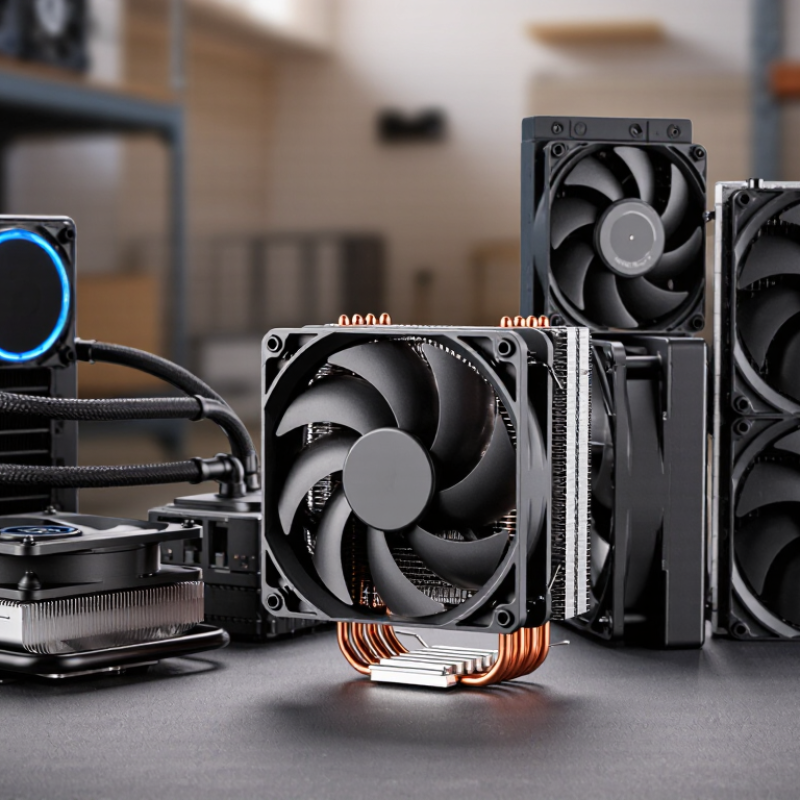
A CPU cooler removes heat from the processor and transfers it into surrounding air. Most systems use a metal heatsink, a fan, or a liquid cooling loop. Without effective cooling, the processor may reduce its speed to protect itself. In severe cases, unstable performance or sudden shutdowns can occur. Coolers matter because modern processors generate concentrated heat during gaming, rendering, and continuous business workloads. A reliable cooler keeps temperatures more consistent and supports longer component life.
From practical system building, cooler selection should match the processor’s power demand, case airflow, and working environment. A large cooler is not automatically better. It may block memory slots or create installation pressure. Fan quality, mounting strength, noise control, and dust resistance also affect daily results. Thermal paste helps fill microscopic gaps between surfaces, but it cannot fix poor contact. I have seen small installation mistakes cause larger temperature changes than expected.
Tips: Check the cooler’s rated heat capacity before ordering. Confirm socket compatibility and case height clearance. Keep front-to-back airflow clear. Clean dust filters regularly. Monitor temperatures during real workloads, not only during short tests. Liquid coolers need extra attention because pumps and tubing can eventually degrade. Air cooling is often simpler and easier to maintain. Still, every design involves trade-offs. A quieter setup may run warmer, while a powerful fan can become distracting. Test the finished system under realistic conditions before trusting the numbers.
CPU coolers transfer heat away from the processor and help maintain stable performance. The chart shows representative maximum heat-dissipation levels commonly associated with major cooler categories. Actual performance depends on the CPU, case airflow, fan speed, mounting pressure, ambient temperature, and thermal compound.
China’s CPU cooler manufacturing landscape has evolved from basic metal fabrication into a layered engineering industry. Manufacturers now produce air coolers, liquid cooling assemblies, heat pipes, cold plates, fans, and mounting hardware. Many facilities combine CNC machining, aluminum extrusion, soldering, injection molding, and automated assembly under one production system. This integration can shorten development cycles for global buyers.
Factory experience matters in thermal design. Engineers typically evaluate fin density, copper contact quality, fan pressure, pump noise, and thermal paste performance. Reliable suppliers use thermal chambers, airflow meters, vibration tests, and aging trials before mass production. They also inspect flatness on the cooler base, because small gaps can increase processor temperatures. Certification support, traceable materials, and documented quality procedures are important for overseas distribution.
However, the market is not uniformly mature. Some suppliers present impressive prototypes but lack stable process control during larger orders. That gap deserves careful attention. A buyer should compare pilot samples with production units, review failure data, and verify packaging strength through drop testing. Communication can also become imperfect when technical specifications are translated too loosely. Clear drawings, torque limits, noise targets, and acceptance standards reduce disputes. Smaller factories may offer flexible customization, yet their testing equipment can be limited. Larger facilities often provide stronger consistency, though their minimum order quantities may be less accommodating. Temperature results alone are not enough. Long-term reliability, acoustic behavior, installation accuracy, and service responsiveness reveal the real manufacturing capability.
A brand-neutral reference table for evaluating China-based CPU cooler production capabilities and export requirements.
| Evaluation Dimension | Typical China Manufacturing Landscape | Technical Reference Data | Global Buyer Considerations |
|---|---|---|---|
| Main Product Categories | Air coolers, all-in-one liquid coolers, low-profile coolers, server coolers, and passive or semi-passive heatsinks. | Air coolers use heatsinks and fans; liquid coolers add a pump, radiator, tubing, coolant, and cold plate. | Select the product class according to thermal load, chassis clearance, operating noise, service life, and target price. |
| Common Manufacturing Regions | The Pearl River Delta and Yangtze River Delta are widely used sourcing areas for metal forming, tooling, plastics, electronics assembly, and computer hardware components. | Regional supply chains commonly support CNC machining, stamping, die casting, injection molding, fan assembly, and packaging. | Compare factory location, port access, component sourcing distance, tooling ownership, and export experience. |
| Heatsink Materials | Aluminum is common for fins and bodies; copper is frequently used for base plates, heat pipes, and vapor chambers. | Typical thermal conductivity at room temperature: aluminum approximately 200–240 W/m·K; copper approximately 390–410 W/m·K. | Request alloy specifications, surface treatment details, base flatness, solder or sintering method, and corrosion-control requirements. |
| Heat Pipe Production | Manufacturing commonly includes copper tube forming, wick installation, vacuum evacuation, working-fluid charging, sealing, bending, and thermal testing. | Common heat pipe outside diameters include approximately 4 mm, 6 mm, and 8 mm, depending on cooler size and heat-transfer design. | Verify leak testing, vacuum consistency, bend-radius control, charge quantity, and thermal performance after forming. |
| Indicative Thermal Classes | Entry-level, mainstream, high-performance, workstation, and server-oriented designs are available through OEM and ODM production. | Indicative design groups are below 65 W, 65–125 W, 125–250 W, and above 250 W thermal design targets. These ranges are not a universal performance rating. | Require standardized test conditions, ambient temperature, test processor or heater load, fan speed, thermal paste, and mounting pressure. |
| Fan Configuration | Single-fan, dual-fan, push-pull, slim-fan, and high-static-pressure configurations are commonly manufactured. | Common fan frame sizes include 92 mm, 120 mm, and 140 mm. Four-wire PWM control is widely used for variable-speed operation. | Compare airflow, static pressure, acoustic output, bearing type, rated voltage, PWM response, and expected operating life. |
| Liquid Cooler Capabilities | Production may cover cold plates, pumps, radiators, tubing, reservoirs, liquid filling, sealing, leak testing, and full-system assembly. | Common radiator formats include 120 mm, 240 mm, 280 mm, and 360 mm classes, subject to chassis compatibility. | Request continuous leak testing, pump-life data, coolant compatibility, transport testing, tubing permeation data, and warranty procedures. |
| Surface Finishing | Available processes include anodizing, nickel plating, passivation, painting, powder coating, polishing, and brushed-metal finishing. | Finishing affects corrosion resistance, appearance, emissivity, solderability, and contact-surface performance. | Confirm coating thickness, adhesion, salt-spray requirements, color tolerance, RoHS compliance, and contact-area masking. |
| Quality-Control Testing | Typical controls include incoming-material inspection, dimensional checks, fan balancing, thermal testing, noise testing, vibration testing, aging, and packaging inspection. | Key measurements include thermal resistance, temperature rise, airflow, static pressure, rotational speed, acoustic output, leakage, and electrical safety. | Request inspection plans, calibration records, lot traceability, sample approval procedures, and corrective-action reports. |
| Compliance Framework | Export-oriented factories commonly prepare documentation for product safety, restricted substances, chemicals, packaging, and electromagnetic compatibility requirements. | Frequently requested references include EU RoHS Directive 2011/65/EU, REACH Regulation (EC) No. 1907/2006, WEEE requirements, and applicable electrical or EMC standards. | Compliance depends on the destination market and product configuration. Obtain current test reports and declarations before shipment. |
| OEM and ODM Flexibility | Many manufacturers can support custom dimensions, fin geometry, mounting hardware, fan specifications, lighting integration, packaging, manuals, and product labeling. | Customization may involve tooling, engineering validation, thermal simulation, prototype approval, pilot production, and production-change control. | Define ownership of molds, drawings, firmware, test fixtures, tooling maintenance, quality limits, and engineering-change notifications in the contract. |
China’s CPU cooler manufacturers produce several main designs for global buyers. Air tower coolers remain the most common choice for desktop systems. They use copper heat pipes, aluminum fins, and one or two fans. Larger fin stacks usually improve heat dissipation, but they also need more case space.
Low-profile air coolers suit compact computers and office workstations. Their shorter height supports slim cases, although cooling performance can drop under sustained workloads. Liquid coolers are another major category. All-in-one models combine a pump, radiator, tubing, and a cold plate. Radiator sizes often range from 120 mm to 360 mm. Bigger radiators can lower temperatures, but installation becomes less convenient.
Some Chinese factories also produce customized coolers for servers, industrial computers, and gaming systems. These may use vapor chambers, thicker copper bases, or special mounting brackets. During sourcing, I would inspect fin alignment, solder joints, pump noise, and fan balance. These details reveal more than surface appearance. Quality control is not always consistent across factories, so buyers should request thermal test data and sample units. A sample can still mislead. Testing under the target processor, case airflow, and room temperature gives more useful evidence. Packaging matters too, especially for long-distance shipping. A bent fin or loose mounting kit can turn a good design into a frustrating installation.
China’s top CPU cooler manufacturers must prove performance against clear technical standards, not attractive packaging.
ASHRAE TC 9.9 recommends an 18–27°C inlet range for many air-cooled data-center systems. A capable cooler should maintain processor temperature within this range under sustained workloads. Thermal resistance, measured in °C/W, remains more useful than TDP claims alone. Small details matter.
The IEA’s Electricity 2024 report estimates that data centers used about 415 TWh globally in 2024, potentially reaching 945 TWh by 2030. This growth increases demand for efficient fans, pumps, and control systems. Buyers should request airflow curves, acoustic readings under ISO 7779 methods, and performance data at several ambient temperatures. A cooler that performs well at 21°C may struggle at 30°C. Test conditions must be visible. They often are not.
The Lawrence Berkeley National Laboratory’s 2024 report estimates that United States data centers consumed 176 TWh in 2023, with demand possibly reaching 325–580 TWh by 2028. Manufacturers should therefore report cooling power separately from CPU temperature results. PWM response, bearing life, corrosion resistance, mounting pressure, and leak testing also deserve inspection. A one-degree laboratory advantage can disappear inside a dusty chassis. I would not accept a single peak-temperature graph as proof of reliability. Measure twice.
Global buyers should evaluate CPU cooler manufacturers through evidence, not polished catalogs. IDC’s Worldwide Quarterly Personal Computing Device Tracker reported 262.7 million traditional PC shipments in 2024. That volume rewards suppliers with stable capacity, but scale alone proves little.
Ask for measured thermal resistance, noise data, fan-life testing, and results at several loads. A credible factory should provide sample units, test conditions, calibration records, and corrective-action reports. Check copper and aluminum traceability, assembly tolerances, packaging tests, and monthly defect rates. ISO 9001 certification helps, but an audit still matters. A spreadsheet can mislead.
Energy demand makes cooling more important. The International Energy Agency estimated data centers consumed about 460 TWh globally in 2022, potentially exceeding 1,000 TWh by 2026. Buyers should therefore compare sustained thermal performance, not only peak cooling claims. Review factory capacity against forecast orders, lead times, tooling ownership, and backup suppliers. Confirm compliance documentation for destination markets, including restricted-substance requirements and electrical safety obligations. Samples should survive vibration, thermal cycling, and repeated installation. One overlooked detail is mounting pressure; inconsistent pressure can create uneven contact and disappointing field results.
Request a pilot order before signing a long contract. Track yield, delivery accuracy, acoustic consistency, and warranty responses. Cost still matters, obviously. Yet the cheapest quotation may hide thinner materials, weaker testing, or unstable production. I would also challenge my own assumptions: a large facility may have better equipment, but not necessarily better process discipline.
Hi! Simply click below and type your query.
Our experts will reply you very soon.
