Powder Mixing Equipment helps turn separate ingredients into a more consistent blend. The right machine can improve product uniformity, support steady production, and reduce avoidable handling. But choosing a mixer is not just a matter of capacity. Particle size, shape, density, moisture, and flow behavior all affect the result.
Professor John Bridgwater is known for research in particle technology and mixing. A concise paraphrase of a principle reflected in his field of work is: “Good mixing depends on how materials move, not merely on how long the machine runs.” This is a paraphrase, not a verbatim quotation. It points to a practical truth: a longer cycle cannot always correct poor equipment selection or an unsuitable operating setup.
Inside a ribbon blender, for example, inner and outer blades move powder in different directions. A tumble mixer instead rotates a vessel, lifting and folding the material as it turns. Both can work well. Neither suits every blend. A fine powder may cling to a wall, while heavier particles can settle or separate after mixing. Small details matter: a few seconds of discharge, a worn blade, or an overfilled vessel may affect consistency. That is easy to overlook. Real materials can also behave differently from samples tested in a laboratory. This guide explains what Powder Mixing Equipment is, how common mixer designs work, and which practical factors help determine a suitable choice.
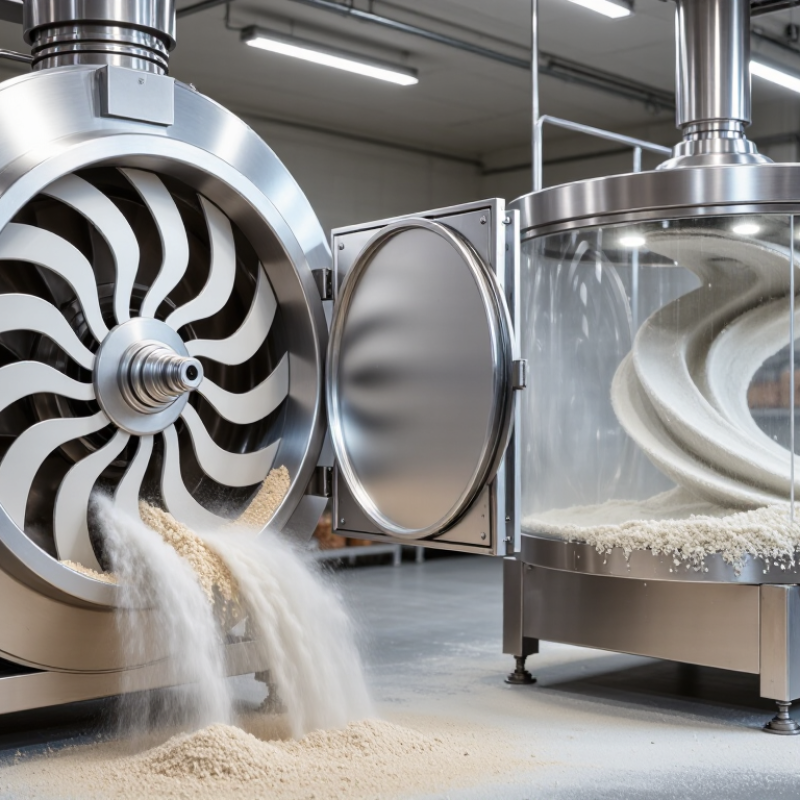
Powder mixing equipment blends dry particles into a more consistent material for production. It is used in food processing, pharmaceuticals, chemicals, and construction materials. Typical machines include rotating drums, ribbon blenders, and paddle mixers. A ribbon blender moves powder along a trough with inner and outer blades; a drum tumbler gently turns free-flowing granules. Picture flour, mineral powder, or powdered ingredients moving through the vessel as the mixer folds and redistributes them. Small differences matter. A uniform blend can support repeatable dosing, product texture, and downstream processing.
Equipment choice depends on particle size, moisture, flow behavior, batch volume, and how gently the material must be handled. A 2023 FAO report estimated that 13.2% of food was lost globally between harvest and retail in 2021. This figure does not measure mixer performance, but it highlights the wider value of careful handling across food supply chains. In practice, operators should check whether powders separate after mixing, cling to vessel walls, or form lumps. A longer mixing cycle is not always better; it can create heat or encourage separation. There is no universal setting. Testing with the actual powder is often the less convenient, but more dependable, answer.
Powder mixing equipment combines dry ingredients inside a vessel designed to move material evenly. The vessel may be a horizontal trough, rotating drum, or vertical cylinder. Its shape affects how powders circulate and how easily the batch can be discharged. Smooth inner walls help limit buildup, though damp or cohesive powders may still cling to corners.
That detail matters.
An agitator moves the ingredients through the vessel. Ribbon blades lift powder from the outer edges and carry it toward the center, while paddles create gentler folding action. A motor and gearbox turn the agitator at a controlled speed. Too much speed can create dust or separate ingredients with different particle sizes.
The inlet allows measured materials to enter; a discharge valve releases the blend into a container or production line. Seals help contain dust around moving shafts, and a control panel lets operators set mixing time and speed. Some systems also use sensors to monitor temperature or motor load. Sensors help, but they do not prove every particle is evenly mixed. Operators still need suitable sampling and cleaning checks, and the best settings may take adjustment between batches.
Powder mixing is a controlled sequence: characterize the materials, load them, blend, then test samples. Before charging, operators check particle size, shape, moisture, and bulk density. A fine powder may cling to a coarse granule; damp material can form stubborn lumps. Small differences matter.
USP General Chapter <1174>, Powder Flow, defines the Hausner ratio as tapped density divided by bulk density. A value around 1.25 or higher can signal reduced flowability, though each material needs its own assessment. Inside a ribbon blender, helical blades move powder both along the trough and across it. A tumbling blender instead lifts and cascades the bed as its vessel rotates. The aim is to distribute ingredients without creating segregation or damaging fragile particles. More time is not always better.
Operators choose fill level and speed based on the powder’s behavior, then take samples from different locations. A single scoop can hide an uneven batch. If sample results vary, the team may adjust loading order, speed, or blend time and test again. That judgment matters: the same settings can behave differently when moisture or particle size changes.
A typical batch powder-mixing workflow, shown in process order
Powder mixers combine dry ingredients through mechanisms such as tumbling, agitation, or fluidization. A typical batch workflow is to load the ingredients, mix them, check whether the blend meets its requirements, and discharge the batch. The exact sequence and mixing conditions depend on the materials and equipment; the stage numbers indicate order, not duration or performance.
Common Types of Powder Mixing Equipment
Powder mixers differ in how they move material, and the right choice depends on particle size, density, flowability, and batch volume. Tumble mixers, such as V-shaped and double-cone vessels, rotate gently, letting particles cascade and redistribute. They suit free-flowing powders that may break under heavy force. Ribbon and paddle mixers use rotating blades inside a trough. Their folding action handles larger batches and powders with varied flow, though they can leave uneven zones if the mixer is poorly loaded. High-shear and ploughshare mixers move material more forcefully. They can disperse small amounts of an ingredient through a larger powder mass, but may generate heat or damage fragile particles. More force is not always better.
Equipment choice also affects dust control and cleaning. NIOSH’s 2006 report on combustible dust documented 281 fires and explosions, with 119 deaths and 718 injuries, in U.S. workplaces from 1980 to 2005. Though not limited to mixers, the figures reinforce the value of enclosed equipment and effective dust collection. Test the actual formulation: bulk density and particle shape can change how a blend moves. The first selection may be wrong.
Tips: Check blend uniformity at several points, not just one sample. Record batch fill level, mixing time, and ingredient addition order. A short trial can reveal dead zones before full-scale production.
| Equipment type | How it works | Typical materials and uses | Key advantages | Considerations | Common operating mode |
|---|---|---|---|---|---|
| V-blender | A rotating V-shaped vessel repeatedly divides and recombines the powder bed, promoting tumbling and diffusion mixing. | Free-flowing powders and granules, such as dry food ingredients, excipients, and other blendable solids. | Gentle mixing; relatively simple vessel design; can be suitable for blends that are sensitive to shear. | Less effective for strongly cohesive powders or blends with large differences in particle size or density; segregation can occur during handling. | Batch |
| Double-cone blender | A double-cone vessel rotates, causing the powder to tumble and circulate as it moves between the two cone-shaped ends. | Free-flowing powders and granules where a gentle, general-purpose blend is needed. | Gentle action and straightforward loading and discharge; useful for many dry-solid blending tasks. | May not provide enough action for cohesive or poorly flowing materials; mixing performance depends on fill level and operating conditions. | Batch |
| Ribbon blender | Inner and outer helical ribbons rotate in a horizontal trough, moving material in opposing axial directions while also turning it radially. | Many free-flowing or moderately cohesive powders, including dry food, chemical, and agricultural blends. | Versatile mixing action; commonly used for medium- to large-scale batches; can handle a range of powder blend tasks. | Can leave material near the vessel ends or around internal components if poorly designed or operated; cleaning may require access to the trough and ribbons. | Usually batch; continuous designs are also available |
| Paddle mixer | Paddles mounted on a rotating shaft lift, fold, and redistribute material through the mixing chamber. | Powders, granules, and some blends containing small amounts of liquid, depending on mixer design. | Flexible mixing action; some designs support rapid mixing and efficient discharge. | The appropriate paddle arrangement and operating conditions depend on flow behavior; liquid addition can cause clumping if not controlled. | Batch or continuous, depending on design |
| Ploughshare mixer | Plough-shaped tools rotate inside a horizontal vessel, vigorously lifting and dispersing the material; optional choppers can break up lumps. | Powders with challenging flow characteristics and blends requiring intensive circulation; some designs also handle liquid addition. | Strong three-dimensional movement; can help disperse agglomerates and distribute small liquid additions. | More intensive action can increase energy use and product stress; tool configuration should match the material and process. | Batch or continuous, depending on design |
| High-shear mixer | A rapidly rotating impeller circulates the material, while a high-speed chopper may break agglomerates and assist with liquid distribution. | Processes such as wet granulation, agglomeration, and intensive blending where strong mechanical action is required. | Can combine mixing with deagglomeration or wet massing in suitable processes. | Generates more shear and heat than gentle tumbling mixers; may not suit materials that are sensitive to mechanical stress. | Usually batch |
Equipment selection depends on powder flowability, particle properties, required blend uniformity, batch size, cleaning needs, and whether the process is batch or continuous.
Powder mixing equipment combines dry ingredients through tumbling, agitation, or controlled circulation. The result depends heavily on the materials. Fine particles may cling to equipment or form dusty pockets, while differences in particle size and density can cause separation. Moisture and static charge matter, too. Small changes can have visible effects.
The mixer’s design, fill level, and operating speed shape how materials move. An overfilled vessel leaves little room for particles to turn; an underfilled one may not create enough movement. More speed is not always better. It can create heat, dust, or unwanted separation. Mixing time needs practical testing, since a longer cycle does not guarantee a more uniform blend.
Loading order also influences performance. A minor ingredient can be premixed with a portion of the main powder before the full batch is added. This helps distribute it, though it is not a cure-all. Operators should take samples from several locations, not just the surface. Compare results across repeat batches. One imperfect detail often gets overlooked: sampling itself can disturb a blend, so use a consistent method and record where each sample came from.
Hi! Simply click below and type your query.
Our experts will reply you very soon.
