- Ambawadi, Ahmedabad, Gujarat
- View Mobile Number

How to Choose a Custom Sewer Jetter in 2026?
Choosing a Custom Sewer Jetter in 2026 starts with the work it must do, not the largest pressure rating on a sales sheet. A crew clearing grease from short service lines has different needs from one maintaining long municipal runs. Note typical pipe diameters, line lengths, access points, and the kinds of blockages encountered. Small details matter. A narrow street or a distant water supply can shape the right truck, trailer, or skid-mounted setup.
Compare pressure and flow together, since pressure alone does not describe cleaning performance. Check whether the water source can support the proposed unit, and ask how hose length and nozzle choice affect operation. Match the power source and tank capacity to your schedule and work locations. Controls should be practical with gloves on, and routine service points should be easy to reach. Ask suppliers for specifications, maintenance guidance, warranty terms, and references for similar applications. A demo on representative pipework may reveal more than a polished brochure.
There is no perfect configuration. It is tempting to add every available option, but extra capacity can bring added cost, weight, and maintenance. Start with documented job requirements, then leave room for realistic future needs. Consider operator training, transport limits, winter storage, and parts availability before signing off. The best choice is the unit your team can use consistently and maintain safely. Some assumptions may prove wrong after a season of work. Review those lessons, and refine the specification with evidence rather than guesswork.
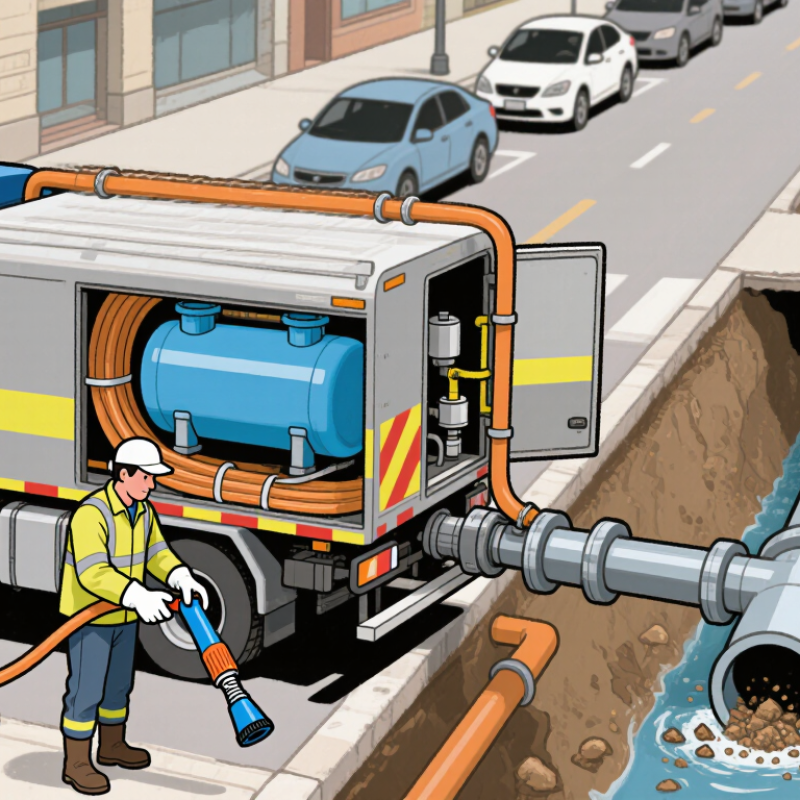
Define the Sewer Jetter’s Jobs, Pipe Types, and Operating Conditions
How to Choose a Custom Sewer Jetter in 2026?
Define the work before choosing pressure or flow. A jetter clearing grease from a restaurant lateral faces different demands than one removing roots or flushing a long municipal main. Record pipe diameter, material, length, access points, and typical blockage. Include bends and elevation changes; they affect hose travel and cleaning performance. PVC, clay, and older cast iron may call for different nozzle choices and operating care. More pressure is not automatically better.
The U.S. Environmental Protection Agency’s 2022 Clean Watersheds Needs Survey estimated $630.1 billion in wastewater infrastructure needs over 20 years. That figure covers broad wastewater needs, not jetters specifically, but it signals the scale of maintenance work. The American Society of Civil Engineers’ 2021 Infrastructure Report Card also rated U.S. wastewater infrastructure C−. These reports make a practical case for matching equipment to routine cleaning, emergency response, or both. Still, a paper specification cannot predict every stubborn blockage.
Tips: Keep a job log. Note pipe size, material, blockage type, hose length, and results after each pass. Ask operators what they actually encounter in the field. A compact unit may suit tight access, while longer runs may need more hose capacity and sustained flow. Check water supply, vehicle payload, and winter conditions before ordering. Small details matter. I’d leave room for adjustment; site records are rarely perfect.
How to Choose a Custom Sewer Jetter in 2026? — Define the Sewer Jetter’s Jobs, Pipe Types, and Operating Conditions
| Typical Job | Pipe Type and Approx. Diameter | Common Blockage or Condition | Planning Flow Range | Planning Pressure Range | Configuration Considerations |
|---|---|---|---|---|---|
| Indoor drain and short branch cleaning | Building drains, typically 1½–4 in. (40–100 mm); confirm pipe material and access limits | Soap residue, grease, soft organic buildup, and small deposits | About 1–4 gpm (4–15 L/min) | About 1,000–2,500 psi (70–170 bar) | Prioritize a compact unit, suitable small-diameter hose, controlled pressure, and fittings compatible with the drain access. Use extra care with older or fragile piping. |
| Residential sewer lateral cleaning | Commonly 4–6 in. (100–150 mm); materials may include clay, cast iron, PVC, or other plastics | Grease, sludge, soft roots, and routine sediment | About 3–8 gpm (11–30 L/min) | About 1,500–3,000 psi (100–210 bar) | Match hose length and diameter to the access point and run. Select suitable flushing and penetrating nozzle options; inspect uncertain or damaged lines before aggressive cleaning. |
| Commercial building drain maintenance | Approximately 4–8 in. (100–200 mm), depending on the drain and building | Grease, scale, accumulated sludge, and recurring deposits | About 5–10 gpm (19–38 L/min) | About 2,000–3,500 psi (140–240 bar) | Consider longer hose capacity, a stable water supply, convenient transport, and nozzle choices for both forward cleaning and rearward hose propulsion. |
| Storm drain and catch-basin cleaning | Often 6–18 in. (150–450 mm); larger systems may require specialized equipment | Sand, silt, leaves, and other loose sediment | About 8–20 gpm (30–76 L/min) | About 1,500–3,000 psi (100–210 bar) | Flow and water volume are especially important for moving sediment. Confirm where flushed material will collect and whether a separate vacuum or disposal process is needed. |
| Municipal sewer line cleaning | Typically 8 in. (200 mm) and larger; confirm diameter, length, and access structure | Heavy sediment, grease, deposits, and some root intrusion | Often 20 gpm (76 L/min) or more, selected for the pipe and cleaning plan | Commonly around 1,500–3,000 psi (100–210 bar), subject to the system and nozzle | Evaluate total water demand, hose management, vehicle or trailer capacity, recovery needs, and safe operation from the access point. Larger lines may call for specialized jetting equipment. |
| Scale or hard deposit removal | Pipe material and condition must be identified; diameter alone does not determine suitability | Mineral scale, hardened deposits, or tenacious buildup | Choose based on the selected nozzle and removal method; adequate flow supports flushing debris | Use only a pressure appropriate for the pipe, nozzle, and deposit | Assess pipe-wall condition first. Consider inspection and a controlled test pass; excessive force or unsuitable tooling can damage weakened, corroded, or brittle pipe. |
| Root intrusion management | Commonly encountered in older sewer laterals and joints; inspect the actual pipe condition | Fine roots or established root masses at joints and cracks | Typically selected for the line size and root-cutting nozzle; flushing capacity is also important | Set according to the cutter, pipe condition, and operating guidance | Jetting can remove roots but does not repair entry points. A camera inspection may help identify damage; recurring intrusion may require pipe repair or rehabilitation. |
| Cold-weather or remote-site operation | Any compatible pipe size for the selected equipment and hose | Seasonal maintenance, isolated sites, or work with limited utilities | Determine from the job’s nozzle, pipe, and available water supply | Determine from the job and the equipment’s rated operating limits | Check water availability, freeze protection, power source, transport, hose reach, and safe drainage. Follow the equipment manufacturer’s operating and winterization instructions. |
Selection note: Flow and pressure ranges are general planning references, not universal specifications. Actual requirements depend on the pipe material and condition, nozzle design, hose size and length, blockage, water supply, and local procedures. Confirm equipment ratings and use inspection where pipe condition is uncertain.
