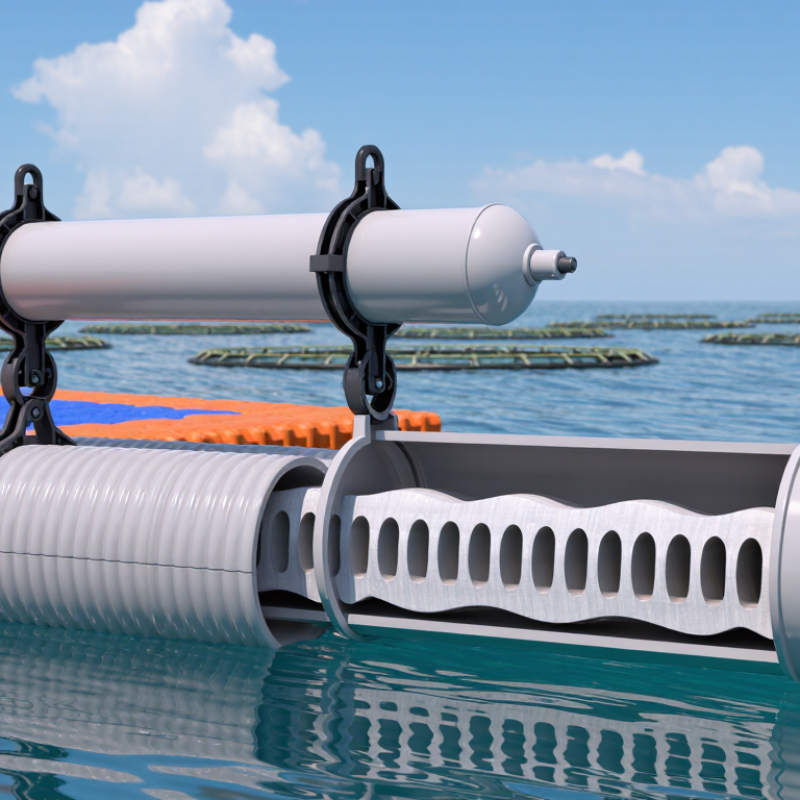
A Hdpe Floater is a hollow or foam-filled buoyant unit made from high-density polyethylene. It supports floating docks, pontoons, aquaculture platforms, pipelines, and temporary marine structures. Its operating principle is simple. Displaced water creates upward buoyant force. When that force exceeds the floater’s total weight, the structure remains afloat.
The material choice is practical. HDPE commonly has a density near 0.94–0.97 g/cm³, below freshwater and seawater, according to ASTM D4976 material classifications. Rotomolded HDPE also resists corrosion, moisture, and many chemicals. These properties help floaters survive repeated contact with water, sunlight, and dock hardware. However, performance depends on design, not plastic alone. Wall thickness, internal ribs, foam filling, ballast, connectors, and wave loads all matter. A large shell can still fail when poorly supported.
Industry data adds useful context. The OECD’s Global Plastics Outlook reported global plastics production of 460 million tonnes in 2019. It also found that only about 9% of plastic waste was recycled. This makes material selection and end-of-life planning increasingly important. The International Maritime Organization and regional marine authorities also emphasize load control, safe access, and inspection for floating installations. Those requirements vary by location.
Real-world judgment remains essential. A floater may look strong beside calm water, then respond differently under wind, current, or uneven loading. That detail is easy to underestimate. Buyers should verify buoyancy calculations, ultraviolet stabilization, weld quality, and manufacturer test records. No single report replaces a site assessment. The best Hdpe Floater is not merely buoyant; it is correctly specified, maintained, and responsibly managed throughout its service life.
An HDPE floater is a buoyant structure made from high-density polyethylene. It usually contains a sealed, hollow chamber that displaces water. This displacement creates upward force, known as buoyancy, and supports platforms, walkways, pipes, or small floating systems.
HDPE is valued for its strength, low moisture absorption, and resistance to corrosion. Unlike steel, it does not rust when exposed to water. Its smooth surface also limits marine growth, although it does not prevent it completely. Many floaters use UV-resistant additives because sunlight can gradually weaken unprotected plastic. Thickness, chamber size, and welding quality affect performance. Small details matter.
The floater works through the balance between upward buoyant force and downward weight. When connected modules enter the water, each module pushes water aside. The greater the displaced volume, the greater the potential load capacity. However, a high load can reduce freeboard and make the platform less stable. Engineers therefore check total weight, wave conditions, connections, and expected movement before installation. I have found that simple visual checks are often underestimated. Inspecting cracks, loose fasteners, distorted chambers, and damaged caps can reveal problems early. No floater is permanently maintenance-free. Even durable HDPE needs periodic inspection, especially after storms or heavy use.
An HDPE floater is a buoyant component made from high-density polyethylene. It floats because the density of solid HDPE is typically lower than that of fresh water and seawater.
The chart compares typical material densities. Unfilled HDPE commonly has a density of approximately 0.94–0.97 g/cm³, while fresh water is about 1.000 g/cm³ and seawater is about 1.025 g/cm³. When an HDPE floater displaces enough water, buoyant force exceeds its weight, allowing it to remain on the surface. Its sealed or hollow design increases overall buoyancy, while HDPE provides low water absorption and good impact resistance.
An HDPE floater is a hollow marine component made from high-density polyethylene. It supports docks, walkways, floating platforms, and service equipment. The material is lightweight, impact-resistant, and naturally resistant to moisture and many chemicals. It does not rust, which matters in wet and salty environments.
Its performance depends on material, design, and buoyancy. HDPE is slightly less dense than water, but the hollow body creates much greater lifting capacity. Archimedes’ principle explains this action: the floater displaces water, and the displaced water pushes upward. A larger enclosed volume provides more buoyant force. Internal ribs can improve stiffness, while rounded corners reduce stress during impacts. Proper wall thickness also limits deformation under changing loads. Still, more plastic does not automatically mean better performance. Excess weight can reduce freeboard and stability.
An HDPE floater stays on water through buoyancy. Its hollow body displaces water, while trapped air keeps its average density low. PlasticsEurope material data places HDPE density near 0.94–0.97 g/cm³, below freshwater at about 1.00 g/cm³. Seawater is denser, near 1.025 g/cm³, so flotation usually improves offshore.
The working principle is simple. More submerged volume creates more upward force. A sealed floater therefore supports pontoons, walkways, pipes, or small platforms.
Internal ribs spread loads and reduce wall deformation. Ballast, connectors, and wave impact still matter.
The USACE Coastal Engineering Manual explains that floating structures must account for wave forces, current, wind, and freeboard. A floater may look stable in calm water but behave differently during short, steep waves. That detail is often underestimated.
Tips: Check the rated load, not only the visible size. Leave safety margin for people, equipment, rainwater, and marine growth. Inspect seams, welds, fasteners, and UV damage regularly. ASTM D792 can verify polymer density, but density alone cannot confirm complete system safety.
No design is perfect. Local testing remains valuable, especially where water levels and wave conditions change quickly.
An HDPE floater is a hollow, buoyant structure made from high-density polyethylene. It supports floating equipment above water. The material resists corrosion, impact, and many common chemicals. Unlike metal, it does not rust when exposed to saltwater or moisture. Its practical value appears in demanding operating environments.
HDPE floaters commonly support aquaculture cages, floating walkways, pontoons, water-treatment equipment, and service platforms. They can also stabilize floating pipes and temporary work systems. In calm ponds, the main concern is usually load distribution. In coastal water, waves, tides, salt, and ultraviolet exposure create greater stress. Strong currents can twist connections. Anchoring matters.
A reliable design matches buoyancy with the total operating load. That load includes people, tools, equipment, water absorption, and movement. If the reserve buoyancy is too small, the platform may sit dangerously low. If the structure is oversized, costs and handling difficulties increase. Real sites are rarely predictable. Wind can change quickly, and uneven loading can tilt a platform.
Experienced operators inspect welds, connectors, anchor lines, and drainage areas regularly. They should check for abrasion near shorelines and impact marks after storms. HDPE requires less maintenance than many materials, but it is not maintenance-free. That assumption causes avoidable problems. Temperature changes also deserve attention, especially in locations with freezing winters or intense sunlight. Proper spacing, secure fastening, and realistic load testing help floaters perform consistently across changing environments.
| Data Dimension | Typical Specification or Range | How It Works or What It Means | Common Applications and Operating Environments |
|---|---|---|---|
| Basic Definition | A hollow or foam-filled buoyant unit manufactured primarily from high-density polyethylene (HDPE). | The floater displaces water. The upward buoyant force counteracts the weight of the floater, attached equipment, and any supported load. | Floating docks, pontoons, aquaculture systems, utility platforms, marine walkways, and temporary work platforms. |
| Buoyancy Principle | Net buoyancy depends on displaced water volume minus the weight of the floater and attached components. | Freshwater provides approximately 9.81 kN of buoyant force per cubic metre of displaced water before the floater's own weight and safety allowance are deducted. Saltwater provides slightly more because it is denser. | Suitable for lakes, rivers, reservoirs, coastal waters, and sheltered marine areas when the design load and local conditions are correctly evaluated. |
| Material Density | Approximately 0.93–0.97 g/cm³ for solid HDPE, depending on grade and additives. | HDPE is less dense than water, which helps it float. Hollow or rotationally molded designs achieve high displacement with relatively low structural weight. | Useful where low weight, buoyancy, impact resistance, and ease of handling are important. |
| Manufacturing Methods | Common methods include rotational molding, extrusion, blow molding, and fabricated sheet construction. | Rotational molding can produce seamless hollow units. Fabricated sheet designs can be configured for larger pontoons, chambers, or custom flotation modules. | Modular dock systems, floating barriers, pipe supports, navigation structures, and custom marine platforms. |
| Typical Form Factors | Cylindrical floats, rectangular pontoons, cube-shaped modules, pipe floats, and custom buoyancy chambers. | Shape affects stability, waterline area, connection layout, draft, and resistance to waves or current. | Rectangular modules are common for docks; cylindrical units are often used for booms, pipelines, and buoyancy supports. |
| Typical Wall Construction | Single-wall hollow construction or double-wall construction with internal ribs, chambers, or foam filling. | Internal geometry improves stiffness and helps limit deformation. Multiple sealed chambers can provide additional operational redundancy. | Double-wall or multi-chamber designs are beneficial for public access docks, work platforms, and systems exposed to impact or uneven loading. |
| Material Strength | Commercial HDPE grades commonly have tensile yield strengths in the approximate range of 20–35 MPa. | Strength is influenced by resin grade, wall thickness, temperature, molding quality, UV stabilizers, and the direction and duration of loading. | Appropriate for moderate structural and impact loads when supported by proper design calculations and connection details. |
| Operating Temperature | Common service ranges are approximately −40°C to 60°C, subject to design, loading, and material grade. | HDPE remains tough at low temperatures but softens as temperature rises. Long-term loads should be reduced or reviewed at elevated temperatures. | Cold freshwater environments, temperate coastal areas, and warm climates; prolonged exposure to hot surfaces or high-temperature fluids requires engineering review. |
| UV and Weather Resistance | Good resistance when UV-stabilized grades and suitable pigments are used. | UV stabilizers slow surface degradation caused by sunlight. Unstabilized HDPE can become brittle or lose surface performance after long outdoor exposure. | Outdoor docks, aquaculture cages, floating solar support systems, marinas, and long-term exposed installations. |
| Water and Moisture Resistance | Very low water absorption, generally below 0.1% by weight for HDPE. | Low moisture uptake helps the material retain buoyancy and dimensional stability in continuously wet environments. | Freshwater and saltwater applications, including submerged or splash-zone service. |
| Chemical Resistance | Generally resistant to water, salts, dilute acids, dilute alkalis, and many common chemicals. | Resistance depends on concentration, temperature, exposure time, stress level, and the specific chemical. Strong oxidizers and some hydrocarbons require compatibility checking. | Wastewater facilities, aquaculture operations, agricultural reservoirs, chemical handling areas, and industrial water systems after material review. |
| Impact Resistance | High impact toughness compared with many rigid plastics, particularly at low temperatures. | HDPE can absorb impact energy and deform without shattering. Sharp objects, repeated impacts, and unsupported spans can still cause damage. | Floating barriers, boat landing areas, work platforms, docks, and installations exposed to floating debris or occasional contact. |
| Load Capacity | Varies widely; it is determined by external dimensions, displacement volume, net buoyancy, structure, connectors, and safety factors. | Rated capacity must include dead load, live load, wave action, wind, current, equipment, people, and uneven loading. Reserve freeboard should be maintained. | Passenger docks, maintenance platforms, floating bridges, pipe crossings, and equipment-support platforms. |
| Stability and Freeboard | Controlled by width, length, center of gravity, waterplane area, load distribution, and remaining height above water. | A wider platform generally offers greater initial stability. Concentrated loads can cause trim, heel, or local immersion even when total buoyancy is adequate. | Pedestrian docks, boarding platforms, floating work areas, and platforms carrying pumps, generators, or other equipment. |
| Connection Systems | Bolted flanges, molded connectors, stainless-steel hardware, hinges, ropes, chains, or flexible couplings. | Connections transfer shear, tension, impact, and wave-induced movement between modules and anchoring systems. Hardware should be compatible with the marine environment. | Modular pontoons, floating walkways, marina fingers, fish-farm service platforms, and temporary floating structures. |
| Anchoring and Mooring | Possible systems include piles, chains, ropes, deadweights, guide cables, and articulated mooring assemblies. | The anchoring arrangement limits drift and controls movement caused by wind, current, waves, tides, and changing water levels. | Reservoirs, rivers, sheltered bays, marinas, aquaculture sites, and floating infrastructure near shore. |
| Common Applications | Floating docks, pontoons, walkways, booms, buoys, pipeline supports, aquaculture platforms, and floating solar structures. | HDPE floaters provide distributed buoyancy and can be assembled into modular systems that are easier to transport, install, and replace. | Residential and commercial waterfronts, ports, fish farms, wastewater plants, irrigation reservoirs, and construction sites. |
| Freshwater Performance | Reliable buoyancy in lakes, rivers, ponds, reservoirs, and canals when properly sized and anchored. | Freshwater has a lower density than seawater, so a slightly larger displaced volume may be required for the same supported load. | Floating irrigation intakes, recreational docks, water-treatment facilities, and reservoir service platforms. |
| Marine Performance | Suitable for sheltered and moderate marine conditions when designed for saltwater, wave, tidal, and corrosion exposure. | HDPE itself does not rust, but metal fasteners, anchors, hinges, and other attached components require corrosion-resistant selection and maintenance. | Marinas, coastal walkways, aquaculture farms, floating barriers, and nearshore service platforms. |
| Limitations | Not automatically suitable for severe waves, high-speed currents, heavy point loads, high temperatures, or incompatible chemicals. | Excessive loading, poor anchoring, fatigue, abrasion, UV degradation, and thermal expansion can reduce service life or stability. | Open-ocean installations, high-energy rivers, industrial chemical exposure, and heavy-duty platforms require site-specific engineering. |
| Inspection and Maintenance | Periodic inspection of shells, seams, welds, connectors, anchors, freeboard, and signs of deformation or leakage. | Cleaning prevents buildup from algae, sediment, and marine growth. Damaged modules and corroded hardware should be repaired or replaced promptly. | All permanent outdoor installations, especially public docks, aquaculture systems, and platforms exposed to waves or debris. |
| Environmental Considerations | Long service life and recyclability are potential advantages, but damaged plastic must be collected and managed responsibly. | Proper design, installation, inspection, and end-of-life recycling help reduce plastic loss and environmental impact. | Projects in environmentally sensitive waterways, protected coastal areas, reservoirs, and aquaculture zones. |

An HDPE floater is a hollow, buoyant module made from high-density polyethylene. It supports docks, walkways, platforms, and utility lines by displacing water. HDPE typically has a density of about 0.94–0.97 g/cm³, so sealed chambers remain lighter than the water they displace. Connection pins distribute movement between modules. However, wave loads can concentrate around joints.
Maintenance begins with visual inspections. Check weld seams, access covers, connection pins, and anchor points for cracks, distortion, abrasion, or water intrusion. The U.S. Army Corps of Engineers Coastal Engineering Manual recommends considering wave climate, currents, and repeated loading during marine inspections. Cleaning should remove algae and trapped debris without damaging the surface. A six-month inspection gap may seem harmless. It is not.
The Plastics Pipe Institute’s Handbook of Polyethylene Pipe reports that properly designed HDPE systems can often exceed 50 years of service under suitable conditions. That figure does not guarantee the same life for every floater. Ultraviolet exposure, impact, overloading, and poor anchoring can shorten it sharply. The European Chemicals Agency identifies carbon black as an important UV stabilizer in outdoor polyethylene applications, but stabilizer content alone cannot correct bad design. Inspect after storms, even when damage is not obvious. Replace weakened hardware promptly. Service records should include inspection dates, load changes, repairs, and unusual movement. Mistakes happen, especially where hidden flotation chambers are involved.
Hi! Simply click below and type your query.
Our experts will reply you very soon.