7 Green Sand Casting Tips for Global Buyers
Buying castings across borders can make small process details feel surprisingly large. A sample may look sound under bright factory lights, yet show porosity after machining. Green Sand Casting remains widely used for iron and other metals because prepared sand molds are adaptable and economical. Results still depend on controls, not just the process name.
This guide, “7 Green Sand Casting Tips for Global Buyers,” focuses on checks that help buyers ask better questions before approving production. Review the pattern, mold design, sand condition, pouring practice, and inspection plan with the supplier. Ask how moisture and sand properties are monitored. Request clear records for sample dimensions, material grades, and any agreed mechanical tests. Practical evidence matters.
Look closely at the details. A thin wall, a sharp corner, or an uneven parting line can affect filling and finishing. Photos help, but they cannot replace a drawing review or a measured first article. Small point.
No checklist guarantees a perfect casting. Foundries use different equipment, alloys, and quality systems, so one supplier’s limits may not fit another’s. Buyers should confirm acceptance criteria in writing and discuss defects openly, including what happens when results fall short. I have seen teams assume a familiar process means familiar quality; that assumption can fail. Use these tips as a starting point, then verify each claim against the part’s design, intended use, and inspection results.
How Green Sand Casting Works and Which Parts Suit the Process
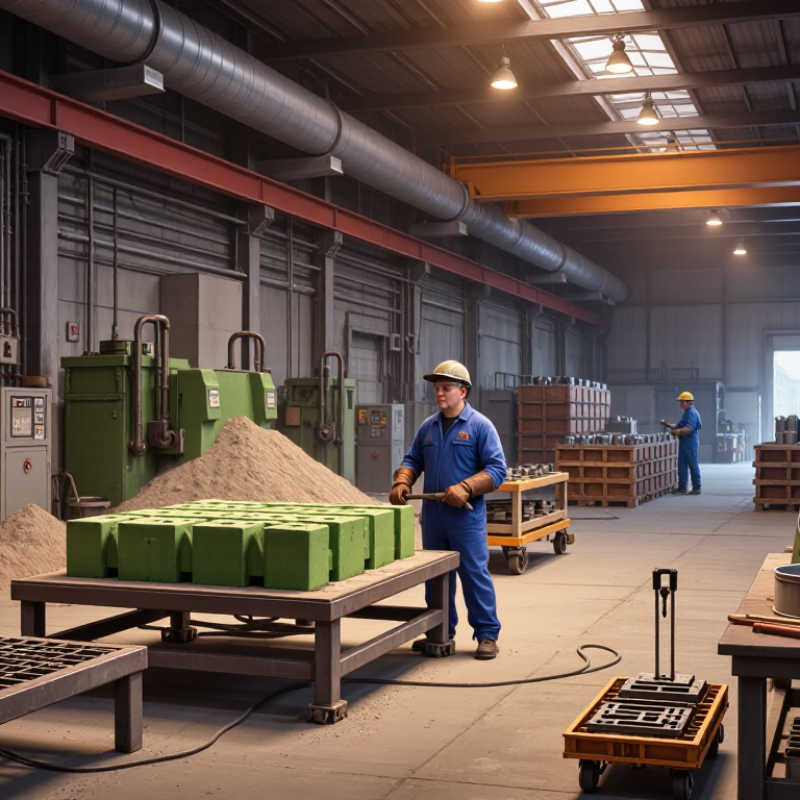
Green sand casting uses silica sand mixed with clay and water to form a reusable mold. “Green” means the sand is damp, not that it contains green material. A pattern shapes the cavity, and workers compact the sand around it before removing the pattern. The mold is assembled in two halves, then molten metal is poured through a gating system. Simple sequence.
The process suits parts with practical, moderately simple geometry, such as pump housings, brackets, valve bodies, and machine bases. It can handle a wide range of sizes, including bulky components that would be costly to machine from solid stock. Draft angles help patterns release cleanly, while cores create internal passages. Those passages need careful support; a misplaced core can leave a wall too thin.
Green sand molds are economical for many iron castings, but they do not produce every finish or tolerance. The surface may show a grainy texture, and machining is often needed on sealing faces or bearing seats. That matters. Buyers should share drawings, alloy requirements, critical dimensions, and expected production volumes before selecting the process. A small trial casting can reveal distortion, porosity, or awkward machining access. It is not a perfect prediction of every production run, but it can expose assumptions early.
Green Sand Casting: Typical Metal Melting Points
Green sand molds are made from moist sand and clay and can be used for both ferrous and nonferrous metals. The chart shows approximate melting points—not pouring temperatures. Actual values vary by alloy, and casting temperature must be selected for the specific metal and part design.
Define Material, Dimensions, and Performance Requirements
Green sand casting orders become more dependable when buyers define the material before requesting a price. Specify the alloy and grade, applicable standard, and any heat-treatment condition. For iron castings, “gray iron” or “ductile iron” alone leaves too much open to interpretation; identify the required grade, such as an ASTM A48 or ASTM A536 class. Small details matter. Share the part’s intended use and operating environment, too.
Dimensions need equal care. Send a controlled drawing with units, datums, critical dimensions, and clearly marked machining surfaces. State where tolerances are essential, rather than applying tight limits to every feature. Agree on draft, machining allowance, and inspection methods with the foundry before production. Green sand molds can shift or deform slightly, so confirm achievable tolerances for the part’s shape and size. A drawing can look complete and still omit a feature that matters on the shop floor.
Define performance in measurable terms: load, temperature range, impact needs, or pressure and leak-test criteria. The American Foundry Society’s 57th Census of World Casting Production reported 109.5 million metric tons of castings produced worldwide in 2022. That scale makes clear why precise, shared specifications matter across suppliers. Still, a number on a drawing cannot replace a trial casting and agreed inspection plan. Be ready to revisit assumptions after the first sample.
Review Pattern Design, Tolerances, and Surface-Finish Needs
Pattern design determines whether a green-sand casting fills cleanly and releases without damage. Keep wall sections reasonably uniform, add draft to vertical faces, and avoid sharp internal corners. These choices reduce abrupt cooling changes and make pattern withdrawal easier. Small details matter. A deep, narrow pocket may trap sand or need a core, adding cost and inspection steps. Share the casting’s function and critical dimensions with the foundry before freezing the design.
Set tolerances by function, not habit. ISO 8062-3:2023 defines 16 casting-tolerance grades, CT1 through CT16; the appropriate grade depends on process capability and casting size. Tighter dimensions can require machining, so mark only surfaces that control assembly or fit. Ask suppliers to state their proposed grade and measurement method. A drawing alone may leave room for assumptions.
Surface finish needs the same practical review. ASM Handbook process data commonly place sand-cast surface roughness around 6.3–25 μm Ra, though sand grain, mold condition, coating, and cleaning affect results. Treat that range as a starting point, not a guarantee. Specify whether the part will be machined, painted, or used as-cast, and identify visible faces. One missed detail can mean extra grinding. Samples help. Compare the agreed finish under consistent lighting, and record any areas where texture is acceptable.
Verify Foundry Quality Controls, Testing, and Traceability
A foundry’s quality system should be visible in its records, not just described during a sales call. Ask how operators control sand moisture, temperature, compactability, and permeability. These values can affect mold strength, surface finish, and casting consistency. Request recent process logs and ask how staff respond when readings drift beyond internal limits. Ask to see them.
Testing should match the part’s function and agreed specifications. Review dimensional inspection reports, material chemistry results, and mechanical test data where required. For critical areas, clarify whether suitable non-destructive testing is available and how indications are recorded. Check that samples come from representative production, not only a carefully prepared trial piece. A neat sample proves little by itself.
Traceability connects each casting to its production history. Confirm that markings or records link the part to its pour, material batch, inspection results, and shipment documents. Ask how the foundry handles nonconforming parts and whether corrective actions are documented. A simple lot number can be useful, but only if staff can retrieve its records quickly. Paperwork sometimes looks complete while gaps remain; test the system with one actual casting before placing a large order.
Compare Total Costs, Lead Times, and Export Readiness
For green sand castings, compare landed cost, not just the quoted price per part. Ask suppliers to separate pattern costs, casting, machining, inspection, protective packing, and freight. Then compare quotes at the same annual volume and quality level. A low casting price can disappear when extra machining or rework is added. Small details matter. Request sample dimensions, inspection records, and clear assumptions about acceptable defects before approving production.
Lead time includes more than molding. Allow for pattern making, sample approval, production capacity, inland transport, and port delays. UNCTAD’s Review of Maritime Transport 2024 reports that over 80% of world trade by volume moves by sea, making shipping schedules a real cost and timing factor. Ask for a production schedule and a separate transit estimate. Export readiness needs attention too: confirm crate dimensions, moisture protection, shipment documents, and the importer’s classification requirements. Ask for evidence. A buffer is not waste, though the right buffer depends on the route and season. Supplier estimates can still miss; review them against recent shipment records before setting delivery dates.

