How to Choose PET Tape for Journals
Choosing PET Tape For Journals is less about picking the prettiest roll and more about matching the tape to your pages, pens, and projects. PET film often gives printed designs a crisp look and a smooth finish, but thickness, adhesive strength, and texture vary between products. A narrow strip can frame a date box, while a wider piece can anchor a collage or cover a small tear. Small details matter. Check the roll’s width, material description, and whether the adhesive is described as removable or permanent. Product labels are not always equally precise, so do not assume every roll will behave alike. Start with a test. Apply a short piece to a spare page, write across it, then lift one corner gently. Check for smudged ink, lifted paper fibers, or unwanted residue.
This guide will help you compare PET tapes by appearance, handling, and suitability for common journaling tasks. Consider whether you want a transparent overlay, a bright printed border, or a matte accent that sits quietly beside your handwriting. Think about the paper, too: thin pages may show impressions or react differently when tape is removed. Even a careful test has limits, since notebook papers and inks vary. That uncertainty is worth remembering. For everyday planning, choose a width that fits your layout and an adhesive that holds without making edits difficult. For decorative spreads, prioritize pattern scale and how clearly the design shows against the page. With a few small tests, you can make a more informed choice and avoid buying a roll that looks lovely but feels wrong in use.
Define PET Tape and Its Common Journal Uses
PET tape is a pressure-sensitive tape made with a thin polyester film, usually polyethylene terephthalate, as its backing. An adhesive layer helps it cling to a page, while the film gives the tape a smooth, often slightly glossy surface. It may be clear, tinted, or printed. Unlike paper washi tape, PET tape can show fine details through transparent areas.
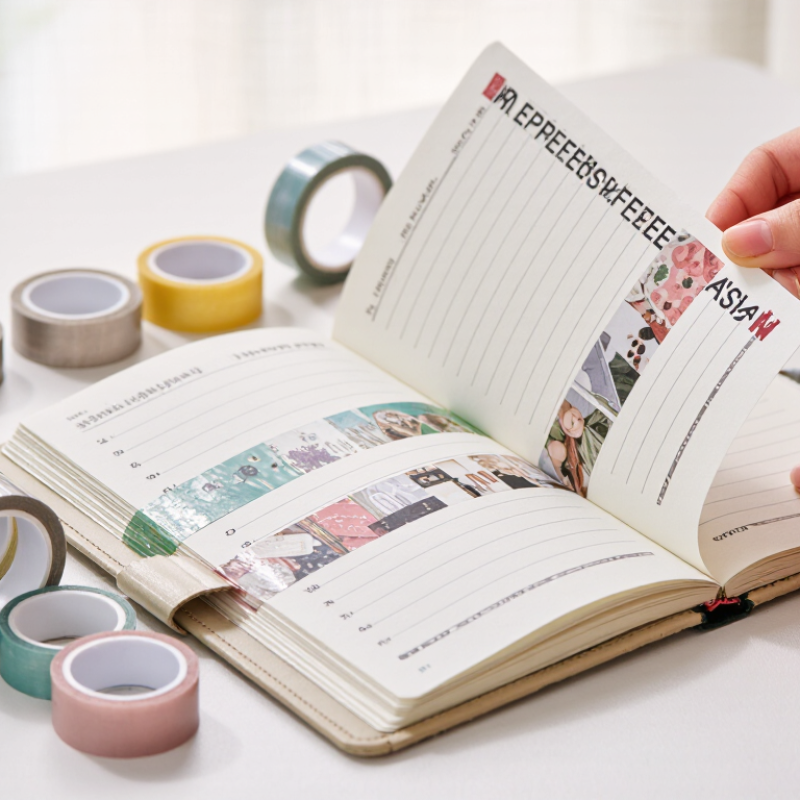
In journals, PET tape is commonly used to frame headings, add borders, or layer small illustrations over notes. Clear designs can sit on top of handwriting without fully hiding it. A strip across a weekly spread can mark a date range; narrow pieces can accent a margin or outline a photo. It stays flat. That makes it useful on pages that already have several layers, though thick overlaps can still feel bulky.
Adhesion varies by product and paper finish. A glossy film may slide slightly on coated pages, while some adhesives can lift fibers from thin paper when removed. Test a small piece on an inconspicuous page first, and press it down with a clean fingertip rather than rubbing hard. It is easy to assume all transparent tape looks invisible; in angled light, reflections may show its edges. That detail can be useful—or simply a little annoying.
Identify the Journal Pages and Decorating Effects You Need
Start with the page, not the pattern. PET tape can look different on coated planner paper, thin notebook sheets, and textured pages. On glossy paper, clear designs often appear crisp. On cream or recycled paper, pale colors may look subdued. Hold a sample over the page in natural light if possible. Check the adhesive on a small corner first; formulas vary, and delicate paper can tear.
Then decide what effect you want. Opaque prints make bold borders or cover small mistakes. Transparent designs let handwriting show through and work well over colored ink. For a layered look, combine a fine floral strip with a wider, calmer pattern. Leave some blank space, too. It is easy to crowd a page when every motif looks appealing.
Consider how you will cut and place the tape. Narrow rolls suit date boxes and page edges, while wider pieces can frame a title or create a background panel. If the tape has a backing liner, save it for storing short offcuts. I sometimes choose a pattern that looks lovely on the roll but feels busy beside my handwriting. A quick test layout can reveal that before the tape is stuck down.
Compare Tape Width, Transparency, Print Quality, and Adhesion
Choose tape width against the page, not just the design. A 10–15 mm strip usually fits narrow margins and small labels; wider tape can cover a header or secure a fold. Check the roll against your journal’s binding, too. A wide strip may wrinkle near the spine. Small details matter.
Transparency affects both layering and legibility. Hold a sample over printed writing and patterned paper in daylight and warm indoor light. Some clear films reveal adhesive haze or a slight tint, which can dull pale colors. For print quality, inspect fine lines, tiny lettering, and color edges under a magnifier. Ask for a sample before ordering; product photos rarely show registration flaws. I still think “crystal clear” can be misleading without a real-paper test.
Adhesion should hold corners flat without tearing thin journal pages during removal. FINAT’s FTM 1 provides a controlled method for measuring peel adhesion, though test results do not guarantee performance on every paper coating. Grand View Research valued the global adhesive tapes market at USD 75.4 billion in 2023 and projected 5.4% annual growth through 2030. That broad market figure is not specific to journal PET tape, so compare actual samples and product specifications rather than treating market growth as proof of quality.
How to Choose PET Tape for Journals
Compare tape width, transparency, print quality, and adhesion
Suggested starting weights for comparing tapes: prioritize print quality and transparency, then check width and adhesion for your journaling style. These percentages are an evaluation guide, not measured product results. Compare samples on your paper before choosing.
Check Ease of Use, Repositioning, and Residue
When choosing PET tape for a journal, check how easily it unwinds and separates from its backing. A stiff roll can tug at lightweight pages, while a very tacky adhesive may catch before the design is straight. Test a small strip on an inside page first. Notice whether it lies flat over a pen line or buckles near the spine. Test before decorating.
Repositioning matters when you are aligning narrow borders or layering small labels. Lift one corner slowly and watch for paper fibers, ink, or page coating coming away. Some tape can be moved once or twice, but repeated lifting may reduce its hold or crease the page. I still find it easy to focus on the pattern and overlook the adhesive; that is usually where trouble starts. Leave the test strip in place for a day, then peel it back at a low angle. Check for tackiness, cloudy marks, or residue along the edge. Results vary with paper finish, ink, and pressure, so a clean test on one journal does not guarantee the same result elsewhere.
Choose a Tape That Fits Your Budget and Storage Needs
Compare PET tape by usable length and performance, not roll price alone. A low-cost roll may waste money if its adhesive lifts from coated pages or leaves residue on thin paper. Buy a small sample and test it on a journal page, a plastic cover, and a kraft-paper pocket. Check the edge after a day. Also note the width and length you actually use; decorative layouts can consume narrow rolls quickly. I still find “value” hard to judge from a listing alone.
Storage affects that value. Keep rolls sealed, away from direct sun, heaters, and damp shelves; label each roll with its opening date. For paper collections, the U.S. National Archives recommends 30–50% relative humidity and 65–70°F storage conditions. This is preservation guidance for paper, not a PET adhesive specification, but it supports avoiding damp, hot storage areas. The EPA’s 2018 materials report recorded a 68.2% recycling rate for U.S. paper and paperboard packaging. That figure does not mean PET tape or decorated journal pages are recyclable, so avoid paying extra based on an unsupported assumption. A dry drawer and a simple inventory may protect your budget better than buying many rolls at once.

