An Overhead Crane Wire Rope is not a generic lifting component. Its construction, diameter, core, and lay must suit the crane’s duty, reeving arrangement, sheave geometry, and working environment. A rope selected only by breaking strength may still wear quickly or perform poorly. The details matter.
The stakes are practical. The International Labour Organization’s 2023 global estimates report about 2.93 million work-related deaths and 395 million non-fatal occupational injuries each year. These figures cover many industries, not crane-rope failures alone, but they underline why lifting equipment deserves careful engineering and maintenance. For wire-rope inspection and discard criteria, ISO 4309:2017 provides a recognized technical reference; ASME B30.30 also addresses wire ropes used in lifting equipment. Neither replaces the crane manufacturer’s specifications or a competent assessment of actual service conditions.
Before comparing rope options, identify the load spectrum, lift frequency, reeving pattern, sheave-to-rope diameter ratio, and exposure to heat, moisture, or abrasion. A compacted strand may suit one duty, while another application may favor a different construction or core. Ask how the rope will be installed, lubricated, inspected, and replaced—not just how it performs on a new-rope data sheet. Small details count. A clean specification can still miss real operating conditions; that is worth checking twice. This guide explains how to evaluate those factors and choose a rope that fits the crane, its workload, and its maintenance plan.
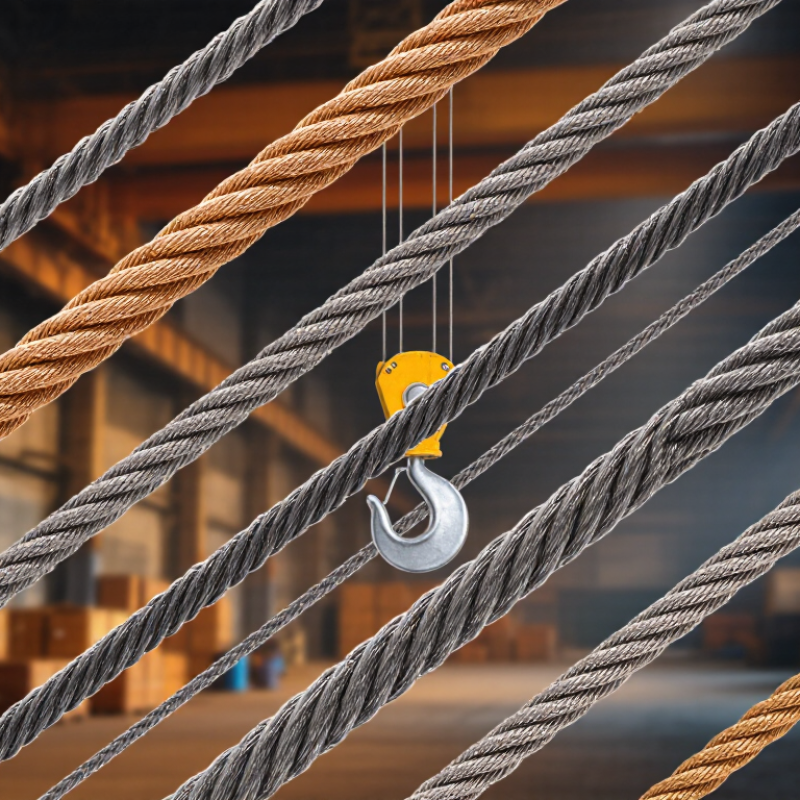
Start by identifying the crane and how its hoist moves the load. A bridge crane travels along runway rails, while a gantry crane moves on legs and wheels. Jib cranes have a different travel path and may impose different rope angles. These differences affect rope travel, side pull, and wear. The route matters. Check the hoist manual for the specified rope construction and diameter.
Next, inspect the hoist design. Count the rope falls and note whether the drum is grooved for a particular rope size or lay. Check the sheave diameters, fleet angle, and whether the system needs rotation-resistant rope. A mismatch can cause poor winding, twisting, or faster wear. Small details matter. I would not choose by breaking strength alone; the rope must also suit the reeving and drum.
Then consider the actual operating conditions. Frequent starts, heavy duty cycles, shock loading, abrasive dust, moisture, and outdoor exposure can change what performs reliably. Look for corrosion, broken wires, flattening, and uneven drum spooling during inspections. Check the actual path. A selection may look correct on paper, yet an overlooked sheave or harsh duty cycle can shorten service life. Compare the site conditions with the hoist maker’s specifications, and ask a qualified crane professional to review any uncertainty.
Overhead crane ropes face repeated bending as they pass over sheaves, then sit under load on the drum. Construction affects how they handle that cycle.
A 6×19 rope uses relatively larger outer wires, which generally resist abrasion well. A 6×36 construction has more, finer wires and bends more readily over smaller sheaves. That flexibility can help with bending fatigue, but the finer wires may wear faster against rough surfaces.
Measure the sheave and drum, and check the rope’s minimum breaking force and manufacturer’s application guidance before choosing.
Core type matters, too. A fiber core (FC) is flexible and can retain lubricant, but it offers less resistance to heat and crushing than an independent wire rope core (IWRC).
The Wire Rope Technical Board’s Wire Rope Users Manual reports that comparable IWRC ropes typically have about 7.5% greater breaking strength than fiber-core ropes.
Treat that as a general comparison, not a guaranteed rating; actual values depend on rope design. IWRC is often the more robust option where drum crushing or heat is a concern. Still, extra strength alone does not ensure longer service life. ISO 4309:2017 calls for inspection of conditions such as broken wires, diameter reduction, and corrosion. Look closely where the rope repeatedly enters the sheave groove. Small changes there are easy to miss.
Choosing an overhead crane rope means matching three variables: diameter, strength, and lay. ISO 2408:2017 specifies minimum breaking-force values by rope diameter, construction, and tensile grade. Compare the required value with the crane manufacturer’s specification; diameter alone does not establish capacity. A thicker rope may still be unsuitable if its construction or strength grade differs. Check the drum and sheave grooves, too. A rope that sits high in a worn groove can suffer uneven contact and accelerated wear. Small details matter.
Lay must suit the reeving arrangement and operating conditions. Right-hand or left-hand lay should match the crane’s design, while regular and lang lay differ in wire orientation and handling characteristics. Don’t swap them based on appearance. ISO 4309:2017 calls for inspection using indicators such as broken wires, corrosion, and diameter reduction. Record the rope’s measured diameter at consistent points, using a caliper rather than guessing by eye. Recheck the manual and inspection history. I would measure twice. Even careful measurements can miss local damage, so a competent inspection remains essential.
Match rope diameter, strength, and lay to the crane. The chart shows how representative minimum breaking force rises with diameter for a 6×36 IWRC steel wire rope with a nominal tensile grade of 1960 MPa.
How to read the chart: These values are illustrative estimates, calculated using a typical 6×36 IWRC rope factor; actual minimum breaking force varies by rope construction, grade, and manufacturer. Minimum breaking force is not the allowable working load. Select a rope that meets the crane maker’s specifications and applicable design factors, and confirm its certified values.
Consider the lay: Regular lay is generally easier to handle and less prone to rotation; lang lay can offer better wear resistance but is more rotation-sensitive. Use only a lay and rope construction approved for the crane and its reeving system.
A compatible rope must match the sheave groove, drum, and reeving—not just the crane’s rated capacity. Measure the rope at several points, then check the groove with a gauge. The Wire Rope Technical Board’s Wire Rope Users Manual gives a commonly used sheave-groove radius of 0.53–0.55 times rope diameter.
A groove that is too tight can pinch the rope; one that is too wide offers poor support. Small mismatch. Check for worn grooves, sharp edges, drum-layering problems, and the rope’s minimum bending diameter.
Do not treat one diameter-to-sheave ratio as universal. ISO 4308-1:2003 provides a selection method that considers rope construction and crane mechanism classification. Confirm the actual rope-and-sheave combination against the crane design documents and applicable local standard.
For overhead cranes in the United States, ASME B30.2 is a key reference; ISO 4309:2017 covers rope care, inspection, and discard criteria. Keep the rope certificate and inspection records with the equipment. A shop-floor measurement can still mislead when the rope is flattened or worn, so have a qualified person verify uncertain dimensions before replacement.
A sound replacement decision starts with the inspection record, not the rope’s age alone. OSHA 29 CFR 1910.179 requires monthly inspection of running wire ropes, with a dated certification record. Inspection frequency may need to increase when service is severe or conditions change. Look closely at the sections that pass over sheaves and drums. They often show wear first.
Use measurable criteria. OSHA specifies removal when a running rope has six randomly distributed broken wires in one rope lay, or three broken wires in one strand within one lay. Check for more than broken wires: corrosion, kinks, crushing, birdcaging, and diameter loss also matter. ASME B30.2 provides guidance for overhead and gantry crane inspection and operation; follow the applicable edition and your site’s procedures. Small clues matter. A polished patch can hide deeper damage.
Record the rope’s location, inspection date, visible defects, and measurements. Compare diameter at the same marked points over time, using the rope maker’s specified limits. Keep photos beside the inspection notes; a close-up with a ruler is more useful than “looks worn.” Replace a rope when it meets removal criteria, or earlier if a qualified inspector judges its condition unsafe. I have seen records miss one detail: the affected rope section. That makes trends harder to assess.
| Inspection Area | What to Check | Typical Inspection Approach | Replacement or Follow-Up Criteria |
|---|---|---|---|
| Broken wires | Count visible broken wires and note their location, distribution, and concentration near end connections or sheaves. | Inspect accessible rope sections while the crane is safely secured. Record findings so changes can be tracked. | Remove the rope from service when broken-wire limits in the applicable standard or rope manufacturer’s instructions are reached. Limits vary by rope construction, lay, and application. |
| Rope diameter | Measure diameter at several locations, avoiding flattened or damaged areas that could distort the reading. | Use a suitable rope-diameter gauge and compare readings with the rope’s original nominal diameter and previous measurements. | Investigate measurable reduction or localized change. Replace when the reduction exceeds the applicable discard limit or indicates significant internal wear, core damage, or loss of support. |
| Deformation and distortion | Look for kinks, crushing, waviness, birdcaging, core protrusion, or a rope that has become flattened or otherwise misshapen. | Inspect the full working length, especially where the rope passes over sheaves, drums, and guides. | Remove from service if deformation is severe, affects proper reeving, or meets a discard criterion. Do not attempt to straighten a kinked or birdcaged rope for continued use. |
| Corrosion and wear | Check for rust, pitting, abrasion, worn outer wires, and evidence of lubrication loss or contamination. | Pay particular attention to sections exposed to moisture, chemicals, dust, or repeated contact with sheaves and drums. | Replace when corrosion or wear materially reduces wire strength, causes pitting or broken wires, or reaches the applicable discard limit. Correct the source of contamination where possible. |
| Heat or electrical damage | Look for discoloration, fused or annealed wires, weld spatter, arc strikes, and other signs of unusual heating. | Review the rope’s operating history and inspect nearby components for the source of heat or electrical contact. | Take the rope out of service if heat or electrical damage is suspected; have it assessed by a qualified person and replace it if damage is confirmed or its strength is uncertain. |
| End terminations and attachments | Inspect sockets, clips, wedges, swaged fittings, pins, and connection points for cracks, slippage, looseness, corrosion, or deformation. | Check that the termination is correctly seated and that the rope has not slipped or been damaged at the connection. | Stop use if a termination is cracked, loose, deformed, incorrectly installed, or shows rope slippage. Repair or replace only using an approved method. |
| Drum and sheave interaction | Check for poor spooling, crossover damage, sharp grooves, seized sheaves, and incorrect fleet angle or reeving. | Observe rope travel during a controlled operating check, following the site’s safety procedures. | Correct the underlying equipment or reeving problem. Replace rope that has sustained crushing, severe abrasion, or other damage that meets discard criteria. |
| Inspection frequency and records | Consider duty cycle, service severity, environment, rope type, and the crane’s inspection history. | Perform inspections at the intervals required by applicable regulations and standards. Increase attention after unusual events, overloads, or harsh service. | Document findings, measurements, and actions. A qualified person should determine whether a defect requires immediate removal, closer monitoring, or replacement. |
Important: Replacement limits and inspection intervals depend on the crane, rope construction, service conditions, and governing requirements. Follow the applicable regulations, standards, and equipment manufacturer’s instructions; when a rope’s condition is uncertain, secure the crane and obtain an assessment from a qualified person.
Hi! Simply click below and type your query.
Our experts will reply you very soon.
