Choosing an Automatic BOV Aerosol Filling Machine requires more than comparing production speed or equipment price. The right system must protect product quality, maintain accurate filling, and handle bag-on-valve components consistently. As aerosol-packaging engineer Dr. Elena Marquez explains, “A filling machine is only as reliable as its weakest seal.” That principle deserves careful attention.
A practical evaluation begins with container compatibility. Check the machine’s handling range, valve specifications, bag materials, and propellant requirements. The equipment should support stable dosing without damaging the inner bag or distorting the valve. Small variations matter. A few grams of product can affect pressure, spray performance, and customer confidence.
Look closely at the filling sequence. Does the machine control vacuum, product dosing, propellant charging, crimping, and leak testing separately? Independent controls usually make troubleshooting easier. A clear PLC interface also helps operators identify pressure loss, underfilling, or valve misalignment quickly. That saves more than production time.
Hygiene is not optional. Choose stainless-steel contact parts, accessible cleaning areas, and documented sanitation procedures. Confirm whether changeovers are genuinely simple, not merely advertised as “quick.” Ask for operating demonstrations with your actual containers and formulation. A machine may perform well in a showroom, yet struggle with foamy products or narrow tolerances.
Capacity matters, but uncontrolled speed creates waste. Consider output targets, staffing, floor space, maintenance access, and future expansion. Supplier training, spare-parts availability, and technical support should be assessed early.
There is no perfect machine.
The best choice balances accuracy, safety, maintainability, and verified performance. Reflect honestly on your process weaknesses before selecting equipment. That decision often reveals the most suitable Automatic BOV Aerosol Filling Machine.
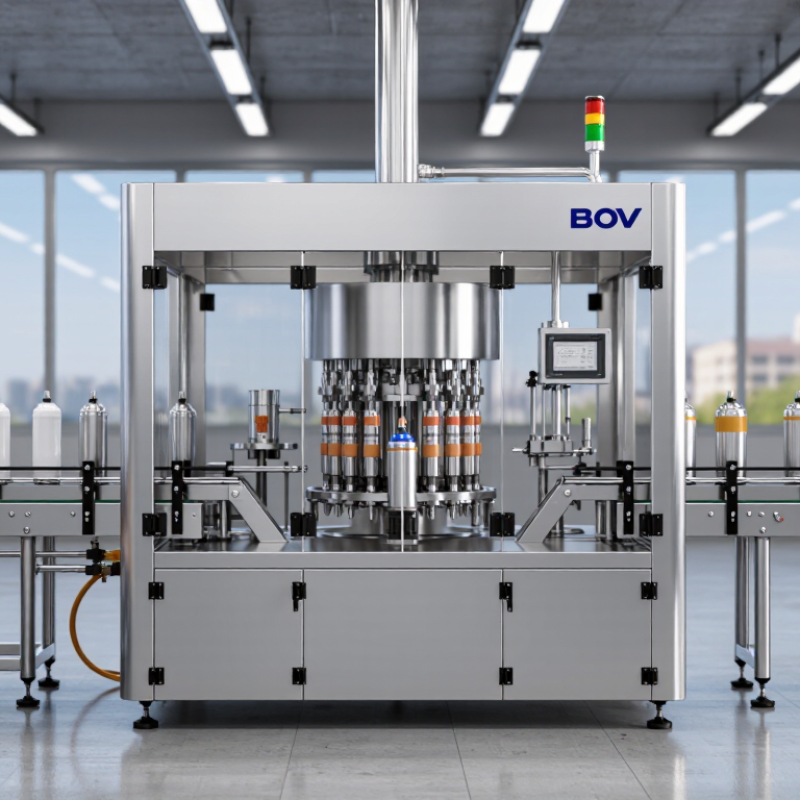
Choosing an automatic BOV aerosol filling machine starts with a precise product profile. Record viscosity, density, pH, temperature sensitivity, and required fill weight. Specify the container diameter, valve type, bag material, and compressed-gas requirement. The machine must match these details, not just the advertised can speed. Grand View Research valued the global aerosol cans market at about USD 11.6 billion in 2023, showing why repeatable filling and reliable quality control matter at scale. Define acceptable weight variation, such as ±1%, before requesting quotations.
Measure twice. Small leaks matter.
Your BOV specification should include product dose, propellant pressure, valve insertion force, crimp dimensions, and target output per minute. Ask for recorded data from factory trials, including fill accuracy, leak-test results, and changeover time. ISO 22768:2020 provides guidance for aerosol container dimensions and tolerances, while the European Aerosol Federation emphasizes pressure testing and controlled filling practices. These references help convert vague requirements into measurable machine functions. However, a clean specification sheet can still miss real production problems. A thick lotion may fill well during a short test, then slow the line after temperature changes. Request trials using your actual formulation, packaging, and operating conditions. Include cleaning access, reject handling, operator safeguards, and batch records. An efficient machine is not always the best machine. Reliability often depends on details nobody notices during a showroom demonstration.
Define the product requirements and BOV filling specifications before selecting a machine. The chart compares common nominal fill volumes with practical liquid dosing tolerance targets for water-based sprays, foaming products, and other low-to-medium viscosity BOV formulations.
Use the required fill-volume range and dosing tolerance to verify pump capacity, metering resolution, valve compatibility, and control-system accuracy. Actual performance depends on formulation viscosity, container geometry, product temperature, propellant ratio, and line speed.
Choosing an automatic BOV aerosol filling machine starts with the formula, not the machine frame. Check viscosity, foaming behavior, acidity, and solvent content before requesting technical specifications. A thin liquid may require different dosing control than a thick lotion. Some formulas also react with unsuitable seals or metal surfaces. Use compatibility charts, then confirm them with actual samples.
Small details matter. The filling path should match the product’s material requirements, while pumps must provide stable volume control. Ask for accuracy data under real production conditions, not only ideal laboratory settings. Test the container diameter, height, shoulder shape, and internal coating. A container that looks standard may still sit poorly on the conveyor. It can wobble during filling.
The valve deserves equal attention. Confirm valve dimensions, gasket material, stem design, and crimping requirements. The machine should place and seal each valve consistently without damaging the container. I once saw a trial pass with empty cans, then fail when filled because the product changed the sealing pressure. That experience is easy to overlook. Run trials with the final formula, container, and valve together. Measure fill weight, leak rate, crimp depth, and line speed. Keep records from several batches. No machine is perfect. A thoughtful supplier should explain adjustment limits, cleaning procedures, and operator training. Choose equipment that supports safe, lawful production and leaves room for careful verification.
How to Choose an Automatic BOV Aerosol Filling Machine
Compare Filling Accuracy, Speed, Automation, and Production Capacity
Choosing an automatic BOV aerosol filling machine starts with filling accuracy. Check the tolerance for both product and propellant. A small error can change spray performance, pressure, and final weight. During factory trials, measure at least thirty containers from each production run. Record the average weight and variation. Do not trust one impressive sample.
Speed matters, but only when the machine remains stable. Ask for tested output under your actual container size and formula conditions. A machine rated at 120 containers per minute may run slower after filling valves, crimping, and inspection are installed. Watch the line for at least one hour. Short demonstrations can hide interruptions. That lesson is easy to overlook.
Automation should reduce manual handling without making maintenance difficult. Look for automatic feeding, valve placement, crimping, leak detection, and weight checking. Clear alarms and accessible changeover parts also protect daily productivity. Production capacity depends on more than speed. Consider shift length, cleaning time, changeover frequency, and rejected containers. I prefer a realistic capacity estimate with a small safety margin. Perfect utilization rarely happens. Review service records, calibration procedures, operator training, and documentation before purchase. A reliable machine should provide repeatable results, not merely impressive numbers.
Choosing an automatic bag-on-valve aerosol filling machine starts with safety systems, not speed. The machine should include guarded moving parts, emergency stops, pressure monitoring, and automatic fault shutdown. Check whether filling stops when containers are missing, misaligned, or damaged. A clear alarm history also helps operators investigate repeated faults instead of resetting them blindly. Explosion protection may be necessary when flammable propellants or cleaning chemicals are present. Confirm this requirement with qualified safety engineers and local authorities.
Hygiene standards deserve equal attention. Product-contact parts should use suitable stainless steel and have smooth, accessible surfaces. Avoid hidden corners where residue can collect. Tool-free dismantling can make daily inspection more realistic. The design should support validated cleaning procedures, controlled water quality, and documented sanitation records. In practice, a polished surface does not guarantee cleanliness. Seals, valves, and filling nozzles often need closer inspection. Small gaps matter.
Regulatory compliance must be verified before purchase. Request technical files, conformity documents, pressure ratings, electrical certifications, and material declarations. Requirements can differ by product type, workplace, and country. Ask the supplier to explain which standards apply to the complete line, not only individual components. Factory acceptance testing should include leak checks, fill-weight accuracy, emergency-stop tests, and container rejection. Records should be signed and retained. No checklist is perfect. Revisit it after installation, operator training, and the first maintenance cycle.
How to Choose an Automatic BOV Aerosol Filling Machine
When comparing an automatic BOV aerosol filling machine, study maintenance before production speed. Ask how often seals, filling valves, sensors, and vacuum pump oil require service. Inspect access panels and confirm whether operators can replace common parts safely. Small details matter. A ten-minute cleaning advantage can save hours each week. Review the machine’s maintenance records, alarm history, and changeover procedure before purchasing.
Supplier support also affects daily reliability. Request documented response times, spare-part availability, remote troubleshooting, and technician training. Check whether manuals include wiring diagrams, calibration steps, and preventive maintenance schedules. A dependable supplier should support factory acceptance testing and installation qualification. However, support promises can sound better than reality. Ask for written service terms and practical examples from similar production environments.
Calculate total operating cost over several years, not only the purchase price. Include electricity, compressed air, cleaning materials, replacement seals, labor, downtime, and rejected units. Measure how quickly the machine reaches stable filling accuracy after startup. A low-cost system may consume more air or need frequent adjustments. I have seen teams overlook changeover labor, then discover that short production runs reduce their margins. Leave room for unexpected repairs. Your calculation will still be imperfect, but it will be more useful when based on real shift data, utility rates, and documented supplier commitments.
| Evaluation Dimension | Key Measure | Typical Planning Range by Machine Class | Why It Matters | ||
|---|---|---|---|---|---|
| Entry-Level | Mid-Range | High-Output | |||
| Suitable Production Volume | Nominal output per hour | 1,000–2,000 cans | 2,000–4,000 cans | 4,000–6,000+ cans | Select capacity based on required saleable output, not only the machine’s maximum rated speed. |
| Overall Equipment Effectiveness | Planning target after stabilization | 70%–80% | 75%–85% | 80%–90% | OEE combines availability, performance, and quality; it is more useful than rated speed for capacity planning. |
| Preventive Maintenance Frequency | Routine inspection and service interval | Daily checks; monthly service | Daily checks; monthly and quarterly service | Daily checks; monthly, quarterly, and annual service | A documented maintenance schedule reduces unplanned downtime and supports consistent fill quality. |
| Recommended Maintenance Labor | Planned technician hours per month | 8–16 hours | 16–32 hours | 24–48 hours | Use local labor rates to convert hours into annual maintenance cost and staffing requirements. |
| Changeover Time | Product or can-size changeover | 45–90 minutes | 30–60 minutes | 20–45 minutes | Quick-release tooling, recipe storage, and accessible filling heads can reduce lost production time. |
| Critical Spare-Parts Availability | Normal delivery time for stocked parts | 2–6 weeks | 1–4 weeks | 1–3 weeks | Confirm availability of seals, valves, sensors, gaskets, hoses, and control components before purchase. |
| Supplier Technical Response | Target response for production-critical issues | 24–48 hours | 8–24 hours | 4–12 hours | A written response-time commitment is more valuable than informal assurances during machine selection. |
| On-Site Service Availability | Typical arrival after confirmed escalation | 3–7 business days | 2–5 business days | 1–3 business days | Travel distance, technician coverage, and spare-parts location directly affect recovery time. |
| Compressed-Air Requirement | Typical operating pressure and consumption | 6 bar; 0.3–0.7 m³/min | 6 bar; 0.5–1.0 m³/min | 6 bar; 0.8–1.5 m³/min | Check compressor capacity, air quality, dryer capacity, and the annual electricity cost of air generation. |
| Annual Maintenance Parts Budget | As a percentage of equipment purchase price | 3%–5% | 4%–6% | 5%–8% | Higher throughput generally increases wear on valves, seals, actuators, conveyors, and filling components. |
| Operator Training Requirement | Initial training for operators and maintenance staff | 1–2 days | 2–3 days | 3–5 days | Training should cover safe depressurization, cleaning, changeover, fault recovery, and preventive maintenance. |
| Indicative Five-Year Ownership Cost | Purchase, installation, maintenance, utilities, and planned service | 1.35–1.65 × purchase price | 1.40–1.75 × purchase price | 1.50–1.90 × purchase price | The lowest purchase price may not provide the lowest total cost when downtime, utilities, labor, and spare parts are included. |
| Planning note: The ranges above are general industry planning benchmarks for comparison purposes, not supplier quotations. Validate actual capacity, utility consumption, maintenance intervals, response times, and five-year ownership costs through a factory acceptance test, written service agreement, and a site-specific cost model. | |||||
Hi! Simply click below and type your query.
Our experts will reply you very soon.
