For global buyers, choosing a Cross Border Trucking partner is not just a rate comparison. A low quote can look attractive until a missed pickup leaves a temperature-controlled shipment waiting at a busy terminal. Reliable providers coordinate drivers, border documentation, handoffs, and delivery updates with care. Small details matter.
This 2026 guide compares leading companies through practical measures: route coverage, shipment visibility, claims support, service consistency, and experience with the buyer’s freight type. American Trucking Associations economist Bob Costello has publicly discussed how freight capacity and costs affect trucking markets. As a paraphrase of that recurring insight—not a verbatim quotation: “Capacity and cost pressures can change the best route or carrier choice.” Buyers should still verify each company’s current coverage, insurance, equipment, and service terms directly. Conditions change.
The strongest fit depends on the lane, cargo, delivery window, and tolerance for disruption. A carrier with broad coverage may not be the best choice for a tight regional schedule. Ask how exceptions are handled, who provides status updates, and what happens when an appointment slips. Compare the answers, not only the sales presentation. No ranking removes uncertainty. This guide offers a grounded starting point, while recognizing that public information may not reveal every service limitation. For a final decision, test assumptions with a lane-specific quote and a clear operating plan.
2026 Top Cross-Border Trucking Companies for Global Buyers
Cross-border trucking companies do more than move freight between countries. They coordinate pickup schedules, border handoffs, customs documentation, and delivery updates. The World Bank’s 2023 Logistics Performance Index assesses 139 economies across six areas, including customs, tracking, and timeliness. These measures show why dependable coordination matters as much as the truck itself. A missing invoice detail or a late border appointment can leave pallets waiting while delivery plans unravel. Small delays grow.
Tips: Ask for a lane-specific transit-time range, the planned border handoff point, and regular shipment updates. Confirm how detention time and cargo claims are handled. Share accurate invoices, packing lists, and shipment weights before pickup; even one mismatch can slow a handoff.
The weak point is often the transition between carriers or local teams, not the highway miles. Ask who monitors the shipment when it crosses the border and who contacts you if plans change. A dashboard helps, but it cannot fix a poorly timed appointment. That handoff still deserves a phone call.
A typical shipment workflow, from planning through delivery
The bars indicate sequence only—not time, cost, shipment volume, or market share. Depending on the route and goods, documentation checks and customs procedures may happen before or during border transit.
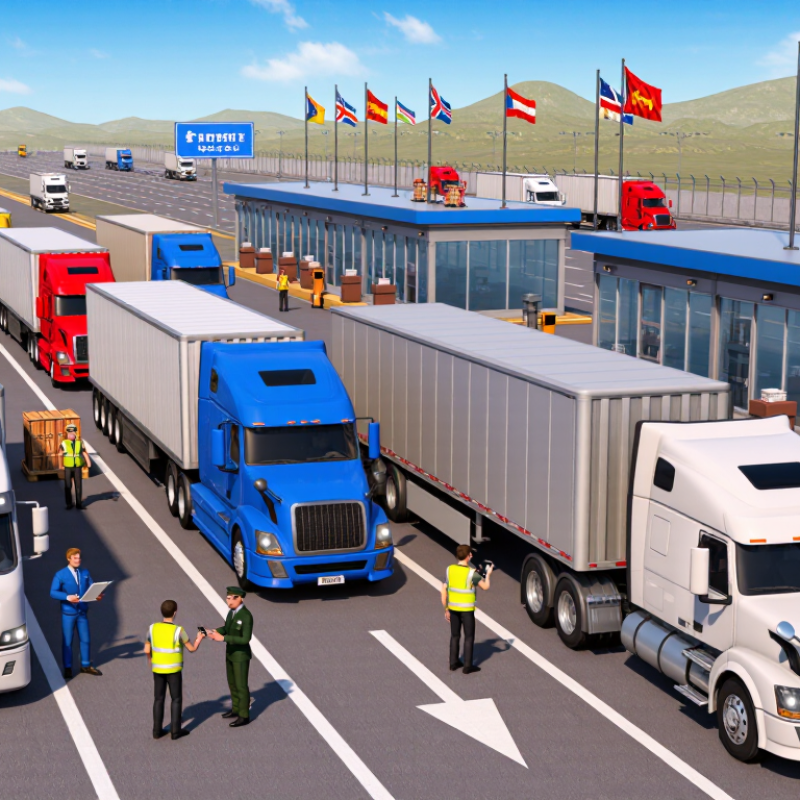
International trucking connects manufacturers, warehouses, and customers across national borders. A truck may collect freight at a loading dock, travel to an inspection point, then continue with the same load or transfer it to another vehicle. Border procedures vary by route, cargo type, and current requirements. Carriers coordinate drivers, dispatch teams, customs representatives, and receiving sites so documents and arrival times align. A missing invoice or mismatched package count can cause delays. Confirm route-specific requirements before departure.
Tips: Check that shipment details match across invoices, packing lists, and transport records. Share delivery windows early. Keep a contact available if an inspection takes longer than expected.
Good service depends on more than a fast vehicle. Dispatchers track progress, flag schedule changes, and coordinate handoffs between drivers or terminals. Clear updates help buyers adjust warehouse staff and unloading equipment before the truck arrives. GPS tracking can show a vehicle’s location, but it cannot predict every queue or inspection. Even a carefully planned route may run late. Ask carriers how they handle delays, document updates, and delivery confirmation, then compare those answers with your shipment’s needs.
Choosing a cross-border trucking partner takes more than comparing quoted rates. Check its experience on your specific lanes, including seasonal capacity and border handoffs. Ask how often shipment milestones update, and whether dispatchers can explain a late scan. A clear estimated arrival time is useful; a realistic explanation for changing it matters more. Small delays matter. Review insurance coverage, claims steps, and pricing details, including fuel or waiting charges. Do not treat a polished tracking screen as proof of reliable operations.
Look for practical contingency plans. A provider should explain what happens when a truck breaks down, a terminal is congested, or weather changes the route. Verify that shipment documents are checked before departure and that responsibilities are clearly assigned. Ask how performance is measured, such as on-time delivery rates and response times, and request recent figures with a defined period. Be cautious of guarantees that sound perfect. Even experienced operators can face disruptions, and that is worth acknowledging. Evaluate how openly they communicate when plans change.
Cross-border trucking companies vary in the routes and services they handle best. In 2026, global buyers should compare regional knowledge, border coordination, and shipment visibility—not just quoted rates. Regional specialists often understand local road conditions and terminal procedures. Their dispatchers may spot delays around busy crossings and adjust pickup times. That can save hours. However, coverage may thin out beyond their core routes.
Larger cross-border networks can offer coordinated transport across several countries, with shared tracking and more consistent handoffs. This suits buyers moving regular loads between multiple markets. Ask how status updates are recorded, who handles customs paperwork, and what happens when a truck misses its planned crossing. Clear answers matter. A broad network alone does not guarantee smooth service; different local teams can still communicate unevenly.
Experienced providers usually plan around real details: loading windows, border operating hours, document checks, and safe parking options. Buyers can request sample tracking updates and written procedures for delays before choosing a carrier. Check insurance terms and confirm which party manages each transport document. A low quote may exclude important services. One imperfect point: performance claims are hard to compare unless the same route, season, and shipment conditions are used. A short trial shipment can reveal gaps that a sales presentation will not.
Matching a cross-border trucking provider starts with the shipment, not the rate card. Map the route, border crossings, cargo dimensions, delivery window, and temperature needs. Then ask who handles customs paperwork, transit updates, and disruption recovery. The World Bank’s 2023 Logistics Performance Index assessed 139 countries across customs, infrastructure, logistics competence, tracking, and timeliness. Use those same areas to assess a provider’s coverage and operating processes. A polished quote is not proof of dependable service.
Capacity matters, too. The International Road Transport Union’s 2023 driver-shortage report identified about 3 million unfilled truck-driver positions across 36 countries. That makes realistic lead times and backup capacity worth checking, especially during seasonal peaks. Ask for recent lane-level delivery records, not just a broad on-time percentage. Confirm whether the provider uses its own fleet or partner carriers, and who you contact when a truck is delayed at a border. Small details matter.
Match equipment to the freight: a standard dry van suits boxed goods, while chilled cargo needs verified temperature monitoring. Check that tracking updates show meaningful events, such as pickup, border arrival, and delivery—not just a moving dot. Compare quotes on the same service scope, including waiting time and accessorial charges. I’d still leave room for uncertainty: a tidy spreadsheet cannot predict every queue, and providers may describe service levels differently. Ask them to walk through a recent disruption and explain what they would communicate, and when.
| Shipping Need | Suitable Trucking Service | Typical Equipment or Handling | What to Check When Selecting a Provider | Cross-Border Considerations |
|---|---|---|---|---|
| Large, regular shipments that can fill a trailer | Full truckload (FTL) | Dedicated trailer; equipment type depends on cargo and lane | Available capacity, pickup and delivery windows, trailer suitability, shipment tracking, and procedures for delays | Confirm who prepares export and import information, who coordinates border clearance, and whether border-related charges are included |
| Smaller shipments that do not require a full trailer | Less-than-truckload (LTL) or groupage | Consolidated freight handled through terminals or partner networks | Terminal coverage, handling frequency, consolidation schedule, cargo protection, and how delivery appointments are managed | Ask how consolidation affects transit time and how customs declarations are handled for each shipment |
| Goods requiring a controlled temperature | Temperature-controlled road freight | Refrigerated or insulated trailer, as appropriate for the required temperature range | Temperature range, monitoring and records, alarm response, pre-cooling procedures, and contingency plans for equipment failure | Verify any product-specific import rules, required health or safety documents, and temperature-record requirements for the destination |
| Heavy, oversized, or unusually shaped cargo | Specialized or project road transport | Flatbed, low-loader, extendable trailer, or other equipment selected for the cargo | Route survey, loading and securing plan, lifting arrangements, insurance scope, and experience with permit coordination | Oversize and weight limits, escort rules, permits, and approved routes vary by country and may also vary within a country |
| Shipments where cost, capacity, or emissions are priorities and timing is flexible | Road-rail intermodal service | Road collection and delivery combined with a rail segment; equipment compatibility depends on the route | Terminal locations, transfer arrangements, schedule frequency, end-to-end visibility, and backup plans for missed connections | Check that every transport leg has a clear responsible party and that customs procedures align with the route and transfer points |
| Time-sensitive freight with a narrow delivery window | Expedited or dedicated road service | Dedicated vehicle or prioritized transport, subject to lane capacity | Realistic transit estimate, driver-hour and rest requirements, dispatch communication, escalation contacts, and delivery confirmation | Border queues, opening hours, customs processing, and local driving rules can affect delivery timing; request a lane-specific plan |
| Any international road shipment requiring customs coordination | Cross-border transport with clearly defined customs support | Equipment selected to match the cargo; customs services may be provided separately or through a broker | Confirm whether the carrier handles transport only or also arranges customs brokerage, document checks, and border appointments | Requirements depend on the countries, goods, and trade arrangement. Confirm applicable commercial invoices, packing lists, permits, and transit documents with the responsible customs professional |
Transit times, pricing, equipment availability, customs procedures, and regulatory requirements vary by route, cargo, season, and service scope. Compare written, lane-specific quotations and confirm responsibilities before booking.
Hi! Simply click below and type your query.
Our experts will reply you very soon.
