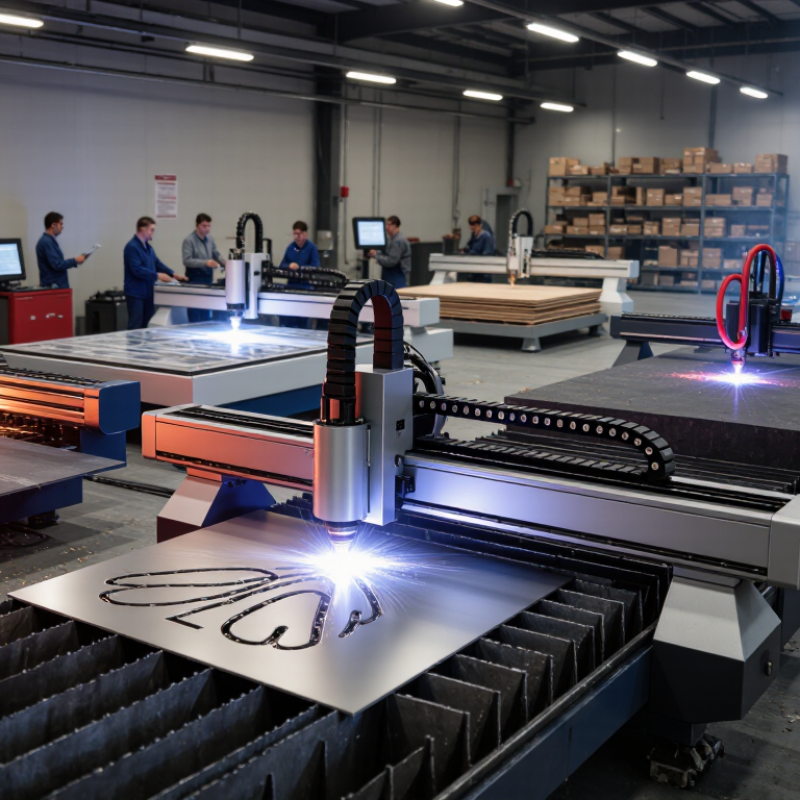
The 2026 CNC Cutting Machine market is becoming more specialized, automated, and difficult to compare. Buyers now evaluate more than cutting speed. They examine material thickness, kerf width, energy use, software compatibility, service response, and operator training. A laser machine may excel on thin stainless steel, while a plasma system may deliver stronger value for thick carbon steel. There is no universal winner.
Industry data shows why this decision matters. Grand View Research estimates that the global CNC machine market reached approximately USD 83.8 billion in 2023 and may expand at a 10.3% compound annual growth rate from 2024 to 2030. The International Federation of Robotics reported 541,302 industrial robots installed worldwide in 2023. These figures indicate stronger automation demand, but they do not guarantee profitable production for every buyer. A forecast is not a purchase order.
Dr. Thomas Kurfess, a manufacturing professor and former SME president, has emphasized, “Manufacturing is the backbone of the economy.” His view reflects an important reality: a Cnc Cutting Machine is a production asset, not simply a catalog item. This guide compares the leading machine types for global buyers, including fiber laser, CO2 laser, plasma, waterjet, oxy-fuel, and CNC router systems. It considers real workshop details, from a dusty fabrication floor to a high-volume sheet-metal line. Maintenance access, local technical support, spare-part availability, and total operating cost deserve equal attention. Some comparisons remain imperfect because suppliers report performance differently. That limitation should be acknowledged, not hidden.
A CNC cutting machine removes material along programmed paths. Its controller converts digital drawings into coordinated motion. The cutting head may use a router, plasma arc, laser beam, or water jet. Each method suits different thicknesses, materials, and edge requirements. The core principle remains constant: position, speed, power, and tool engagement must stay synchronized.
Before cutting, an operator checks the work coordinate, tool offset, and material thickness. A small zeroing error can shift every hole several millimeters. In practical shop work, this mistake is surprisingly common. Clamps matter too. Vibration can leave waves on an otherwise accurate edge. The program controls feed rate and cutting depth, while sensors and operator checks help detect overload, heat, or unstable motion.
Good calibration beats guesswork. Yet settings are not universal. Dense sheet material may need slower feed, while thin stock can warp under excessive heat. The operator should inspect the first cut, measure critical dimensions, and adjust cautiously. This step is often skipped, and that is a weakness. Even a correct file cannot fix a loose clamp or a dirty lens. Routine maintenance includes cleaning cutting surfaces, checking cables, and testing emergency stops. Recording material type, settings, and results makes repeat jobs more reliable.
2026 Top CNC Cutting Machine Types for Global Buyers
Key CNC Cutting Machine Types for Different Materials and Tasks
Choosing a CNC cutting machine starts with the material, not the machine’s advertised speed. In metal workshops, fiber laser systems provide clean edges on mild steel, stainless steel, and aluminum sheets. They suit detailed parts, small holes, and repeated production. Plasma machines handle thicker steel at lower investment, although their cut edges may need grinding. For very heavy plate, oxy-fuel cutting remains practical. It is slower, but its operating costs can be easier to control.
Non-metal materials need different cutting behavior. CO2 laser machines work well with wood, acrylic, fabric, and some plastics. They can produce sharp signs and fine decorative patterns. CNC routers are more flexible for wood panels, foam, plastics, and limited aluminum work. A waterjet cutter uses abrasive pressure instead of heat. It suits stone, glass, composites, and heat-sensitive metals. The process creates less thermal distortion, but water treatment and abrasive disposal require planning.
A useful shop lesson is simple: the fastest machine is not always the most productive. I have seen buyers choose a laser for thick material, then face slow cycles and costly maintenance. That decision looked efficient on paper. It was not. Check material thickness, tolerances, table size, consumable costs, operator training, and local electrical conditions. Safety controls and applicable regional standards also deserve careful verification. Real production samples reveal more than a polished specification sheet.
Typical material suitability by CNC cutting process. Ratings use a practical 0–5 scale based on common industrial applications, where 5 indicates strong suitability.
CNC laser and plasma systems are widely used for sheet and plate metal, while CNC routers are generally preferred for wood, plastics, and composite panels. Waterjet machines are highly versatile and can cut metal, stone, glass, and heat-sensitive materials without creating a heat-affected zone. Actual performance depends on material grade, thickness, power, tooling, abrasive use, and machine configuration.
Choosing a CNC cutting machine starts with the material, not the machine catalogue. Laser cutting suits thin and medium sheet, offering narrow kerfs and limited mechanical stress. Plasma usually cuts thicker steel faster, but it can leave a wider heat-affected zone. Waterjet avoids thermal distortion and handles stone, glass, and layered materials, though abrasive waste and slower setup deserve attention. Oxy-fuel remains useful for heavy steel, but its heat input demands careful edge inspection.
Accuracy claims need context. ISO 230-2 separates positioning accuracy from repeatability; neither measurement alone guarantees a clean finished edge. Ask for test results on your actual thickness, length, and cutting direction.
A small workshop may see a ±0.05 mm figure, then lose it through vibration, thermal drift, or poor workholding. That is easy to overlook.
Speed also includes piercing, nozzle changes, loading, and post-processing. A fast cutting head may produce more dross if settings are poorly matched. Automation changes the calculation. The International Federation of Robotics reported 541,302 industrial robots installed globally in 2023, showing how quickly automated production is expanding.
Still, robots do not correct bad process data. Compare automatic nesting, height sensing, tool monitoring, pallet exchange, and production traceability. Check operator access, too. It matters. In practice, the best choice is often less glamorous: stable accuracy, predictable maintenance, and verified samples from your own material. Industry reports provide useful direction, but real shop-floor trials remain the harder evidence.
2026 Top CNC Cutting Machine Types for Global Buyers
Essential Buying Factors for Global Industrial Applications
Choosing a CNC cutting machine starts with the material, not the machine name. Fiber laser systems suit thin and medium metal sheets with clean edges. Plasma machines handle thicker steel at a lower entry cost. Waterjet equipment cuts heat-sensitive materials, including stone, glass, and composites. CNC routers remain practical for wood, plastics, and aluminum panels. The right choice depends on thickness, tolerance, daily volume, and surface quality.
Measure the real workload. A workshop cutting 8-millimeter steel for ten hours needs different power and cooling than a small fabricator. Check cutting speed under production conditions, not only advertised peak speed. Ask for sample parts using your own material. Inspect edge taper, burrs, kerf width, and hole accuracy. Small details matter. I have seen buyers focus on wattage and overlook dust extraction, compressed-air quality, or table loading time.
Global purchasing adds operational risks. Confirm electrical compatibility, guarding, emergency controls, documentation, and local compliance requirements. Review installation support, operator training, spare-part availability, and remote troubleshooting. Calculate the full cost, including consumables, software, maintenance, freight, and downtime. A cheap machine can become expensive after one failed control board. Still, no checklist is perfect. Production conditions change, and suppliers may describe results too generously. Keep a trial record, question unclear claims, and leave room for future materials, automation, and workforce skills.
| CNC Machine Type | Primary Cutting Process | Common Materials | Typical Working Range | Typical Cutting Speed or Capacity | Typical Accuracy Range | Key Industrial Applications | Main Buying Factors | Advantages | Limitations |
|---|---|---|---|---|---|---|---|---|---|
| Fiber Laser Cutting Machine | Focused laser beam with assist gas | Carbon steel, stainless steel, aluminum, copper, brass, galvanized sheet | Sheet and plate formats commonly from 1,500 × 3,000 mm to 2,000 × 6,000 mm | Thin-sheet travel speeds can exceed 20–40 m/min; practical cutting speed depends strongly on material and thickness | Approximately ±0.03–0.10 mm for well-maintained industrial systems | Sheet-metal fabrication, electrical cabinets, automotive parts, agricultural equipment, HVAC components | Laser power Material thickness, cutting head, gas supply, bed size, nesting software, fume extraction, service support | High productivity, narrow kerf, low mechanical force, suitable for automated production | Reflective metals require suitable system design; operating cost rises with high power and gas consumption |
| CO₂ Laser Cutting Machine | Gas laser cutting with assist gas | Acrylic, wood, plywood, textiles, plastics, rubber, glass, non-reflective metals | Common work areas range from approximately 600 × 400 mm to 2,000 × 3,000 mm | Often approximately 0.5–30 m/min, depending on material, thickness, and required edge quality | Approximately ±0.05–0.15 mm in typical industrial use | Sign making, packaging, interior products, furniture components, textile cutting, prototyping | Laser tube power, optical path stability, material compatibility, ventilation, cooling system, bed size | Effective on many non-metallic materials and capable of detailed engraving | Generally less energy-efficient for metal cutting than fiber systems; reflective metals are unsuitable for many configurations |
| CNC Plasma Cutting Machine | Ionized gas arc melts and ejects conductive metal | Mild steel, stainless steel, aluminum, and other electrically conductive metals | Table sizes commonly range from approximately 1,500 × 3,000 mm to 3,000 × 12,000 mm | Often approximately 2–20 m/min for thin and medium plate, varying by amperage and thickness | Approximately ±0.10–0.50 mm, depending on system class and material | Structural steel, construction equipment, shipbuilding, tanks, frames, general metal fabrication | Power source amperage, plate thickness, torch height control, consumable life, fume and slag management | Fast processing of medium and thick conductive metal at a comparatively low initial cost | Wider kerf and larger heat-affected zone than laser; not suitable for non-conductive materials |
| CNC Oxy-Fuel Cutting Machine | Fuel-gas flame preheats steel and oxygen oxidizes the cut | Carbon steel and low-alloy steel | Large-format tables commonly range from approximately 2,000 × 6,000 mm upward | Often approximately 0.2–1.5 m/min, depending on plate thickness and torch setup | Approximately ±0.50–1.50 mm in common heavy-plate applications | Heavy structural steel, bridges, pressure vessels, ship sections, construction machinery | Cutting thickness, gas infrastructure, torch layout, plate handling, preheating requirements, safety controls | Economical for thick carbon-steel plate and available in very large cutting formats | Slow on thin materials; generally unsuitable for stainless steel and aluminum; produces a larger heat-affected zone |
| CNC Waterjet Cutting Machine | High-pressure water with abrasive or pure-water cutting | Stone, glass, ceramics, composites, rubber, plastics, aluminum, steel, titanium | Common table sizes range from approximately 1,500 × 3,000 mm to 2,000 × 6,000 mm | Cutting feed commonly ranges from approximately 50–500 mm/min for precision work; faster rough cutting is possible | Approximately ±0.05–0.20 mm, depending on machine class, taper compensation, and process settings | Aerospace parts, stone and tile, architectural metals, composites, food equipment, heat-sensitive components | Pump pressure, abrasive management, nozzle life, taper control, water treatment, wastewater handling | Minimal heat-affected zone and broad material compatibility, including heat-sensitive materials | Higher operating cost, water and abrasive consumption, slower production for many routine sheet-metal jobs |
| CNC Router | Rotating cutting tool removes material by milling | Wood, MDF, plywood, plastics, foam, aluminum, composite panels | Common work areas range from approximately 1,300 × 2,500 mm to 2,000 × 4,000 mm | Feed rates commonly range from approximately 5–30 m/min; actual cutting feed depends on tool diameter and material | Approximately ±0.05–0.30 mm for typical production routing | Furniture, cabinetry, signage, molds, architectural panels, packaging prototypes | Spindle power, tool-changing system, vacuum table, dust collection, gantry rigidity, software compatibility | Flexible 2D and 3D cutting, routing, drilling, engraving, and pocketing | Tool wear and dust require management; heavy metal cutting is usually outside its ideal application range |
| CNC Milling Machine | Multi-axis rotary cutting with end mills and other tools | Aluminum, steel, stainless steel, brass, titanium, engineering plastics | Work envelopes vary widely, from compact benchtop systems to large industrial machining centers | Spindle speeds commonly range from approximately 6,000–24,000 rpm; material removal rate depends on spindle power and tooling | Approximately ±0.01–0.05 mm for precision industrial machining | Automotive components, tooling, precision machinery, aerospace parts, medical components | Axis travel, spindle torque, rigidity, tool magazine, rotary-axis capability, thermal stability, chip evacuation | High dimensional control and the ability to produce complex features and three-dimensional parts | Higher purchase and programming costs; cycle time can be long for large-volume material removal |
| CNC Turning Center | Rotating workpiece with stationary or driven cutting tools | Steel, stainless steel, aluminum, brass, copper alloys, plastics, titanium | Typical bar capacities range from approximately 20–100 mm; larger chuck-based machines handle substantially larger diameters | Spindle speeds commonly range from approximately 2,000–6,000 rpm; feed and speed depend on diameter and material | Approximately ±0.01–0.05 mm for precision production work | Shafts, bushings, fittings, rollers, threaded components, hydraulic and pneumatic parts | Chuck or collet capacity, spindle power, live tooling, bar feeder, tailstock, automatic tool changer, chip control | Efficient for cylindrical, conical, threaded, and symmetrical components | Less suitable for large flat profiles or parts requiring extensive non-rotational geometry |
| CNC Wire EDM | Electrical-discharge erosion using a continuously moving wire | Hardened tool steel, carbide, titanium, nickel alloys, conductive specialty metals | Typical workpiece thickness ranges from approximately 100–300 mm, subject to machine design and flushing conditions | Typical rough cutting rates are approximately 50–300 mm²/min; finishing passes are slower | Approximately ±0.002–0.01 mm for precision applications | Progressive dies, stamping tools, precision inserts, medical components, aerospace and mold parts | Workpiece thickness, taper capability, dielectric filtration, wire consumption, surface-finish requirements | Very high precision and the ability to cut hardened conductive materials with minimal cutting force | Only conductive materials can be processed; cutting is relatively slow and requires dielectric management |
| CNC Punching Machine | Mechanical punching, nibbling, and forming with a tool turret | Carbon steel, stainless steel, aluminum, galvanized sheet | Common sheet formats range from approximately 1,250 × 2,500 mm to 1,500 × 3,000 mm | Approximately 300–1,200 hits/min, depending on machine design, stroke length, and material | Approximately ±0.05–0.15 mm for typical sheet-metal production | Electrical enclosures, panels, brackets, cabinets, ventilation components, appliance parts | Turret capacity, tonnage, sheet thickness, repositioning accuracy, forming tools, automation and loading systems | Very productive for repeated holes, louvers, forms, and standardized sheet-metal features | Tool marks and distortion may occur; complex free-form contours may require secondary cutting processes |
| CNC Tube and Pipe Laser Cutter | Laser cutting with rotary or chuck-based tube handling | Carbon steel, stainless steel, aluminum, brass, galvanized tube and pipe | Common round-tube capacities range from approximately 20–220 mm in diameter; larger systems are available | Travel speeds may reach approximately 30–100 m/min; actual cutting speed depends on tube profile and wall thickness | Approximately ±0.05–0.15 mm for typical industrial applications | Frames, handrails, furniture, automotive structures, fitness equipment, agricultural machinery | Tube diameter and length, chuck design, wall thickness, automatic loading, collision protection, nesting software | Combines cutting, drilling, slotting, and contouring in one setup, reducing secondary operations | Less economical for occasional tube work; tube deformation and residual stress can affect accuracy |

Choosing a CNC cutting machine in 2026 starts with the production task, not the machine’s headline speed. A fiber laser suits thin and medium sheet metal, especially when clean edges and repeatable details matter. Plasma handles thicker steel at a lower entry cost, but its heat-affected zone needs careful review. Waterjet cutting protects heat-sensitive materials and supports complex profiles. A CNC router fits wood, plastics, foam, and some composite sheets.
Match the machine to real material sizes. Measure your largest sheet, typical thickness, and daily cutting hours. Check acceleration, positioning accuracy, table loading, extraction, and software compatibility. A powerful spindle is not useful if operators spend hours changing tools.
Ask for sample cuts using your own material. Inspect burrs, corner quality, kerf width, and dimensional drift after several cycles. Small details matter.
Production volume changes the decision. A workshop making custom parts may value flexibility and quick setup. A high-volume line may need automatic loading, nesting, probing, and stable thermal control. I have seen buyers compare only purchase prices, then underestimate extraction, consumables, training, and maintenance. That mistake is expensive. A spreadsheet can still lie. Leave room for imperfect operator habits and future materials. Review service response times, spare-part access, electrical requirements, and local safety compliance before signing. A short trial often reveals more than a polished demonstration.
Hi! Simply click below and type your query.
Our experts will reply you very soon.