- Ambawadi, Ahmedabad, Gujarat
- View Mobile Number

2026 Best Ball Bearing CNC Machine Buying Guide
Choosing a CNC machine in 2026 requires more than comparing prices and cutting speeds. A Ball Bearing Cnc Machine can deliver smooth movement, reduced friction, and consistent positioning when its bearings, rails, and drive system work together. Yet impressive specifications do not guarantee practical performance. A large work envelope may hide weak rigidity, while a fast spindle may create vibration during detailed cuts.
This guide examines the factors experienced machinists and workshop managers should inspect before purchasing. It considers bearing preload, spindle runout, ball screw accuracy, frame construction, controller reliability, and available after-sales support. Small details matter. A 0.01 mm alignment error can appear as visible tool marks on aluminum. Dust protection matters too, especially in woodworking environments where fine particles reach linear components quickly.
Real workshop conditions often challenge manufacturer claims. Actual results depend on material, tooling, operator skill, maintenance, and installation quality. That is worth remembering. No single model suits every user. Some buyers may overvalue cutting speed and underestimate service access or replacement-part availability. Others may choose a compact machine, then discover that its limited travel restricts future projects.
The following buying guide uses practical evaluation methods, technical evidence, and realistic ownership concerns. It aims to help readers compare machines fairly, avoid vague marketing promises, and select equipment that supports reliable production in 2026. Mistakes remain possible, but careful inspection can make them less expensive.
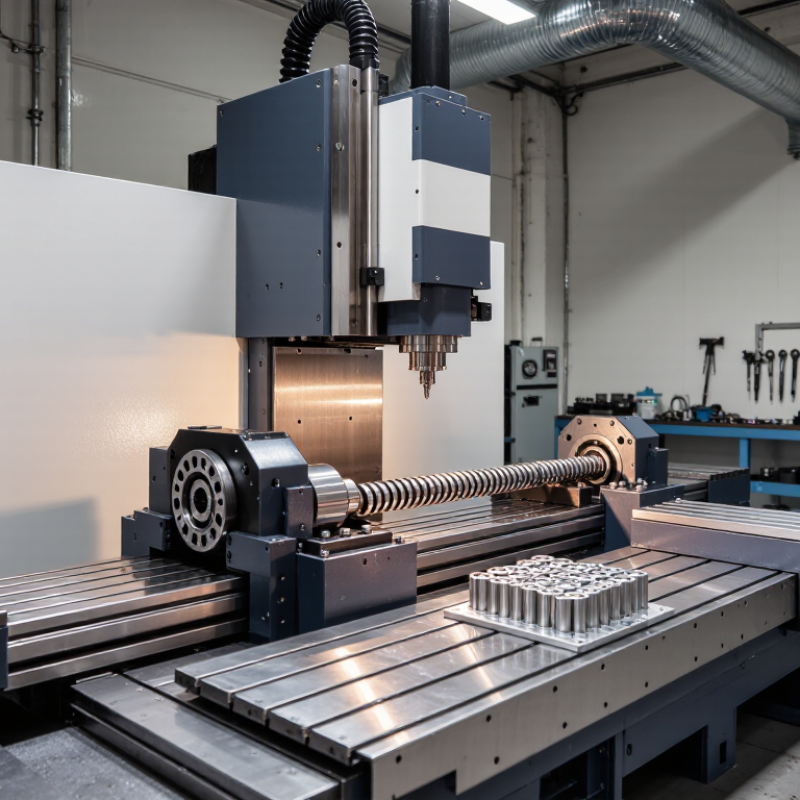
Understanding Ball Bearing CNC Machine Types and Core Functions
A ball bearing CNC machine uses rolling elements to support rotating parts under load. Its spindle converts motor power into cutting motion with controlled runout. Understanding bearing type matters before comparing speed or price. Deep-groove bearings handle radial loads and moderate axial forces. Angular-contact bearings manage combined loads more precisely. Paired bearings can improve stiffness, but preload must match the cutting task. Too much preload creates heat. Too little allows vibration.
Machine structure also changes performance. A compact benchtop unit may suit plastics, wood, and light aluminum work. A heavier frame better resists chatter during steel cutting. The bearing system supports repeatable positioning, while linear guides and ball screws control travel. Sealed bearings reduce contamination from dust and chips. Ceramic-hybrid options may support higher speed, though they often increase cost and require careful setup. In practical inspections, I check spindle noise, temperature rise, axial play, and surface finish. One measurement is never enough. My judgment can still be wrong.
Tips: Ask for spindle speed, permissible runout, bearing arrangement, and maintenance intervals. Run a test cut on your actual material. Listen for changes after warm-up. Check whether replacement bearings are available locally. A glossy specification sheet cannot reveal every weakness. Keep notes.
2026 Best Ball Bearing CNC Machine Buying Guide - Understanding Ball Bearing CNC Machine Types and Core Functions
| Machine Type | Typical Working Envelope | Common Ball-Bearing Components | Primary Core Functions | Typical Spindle or Cutting Range | Positioning and Motion Characteristics | Best-Suited Materials and Applications | Recommended Buyer Profile | Key Buying Considerations |
|---|---|---|---|---|---|---|---|---|
| Desktop CNC Router | Approximately 300 × 300 to 600 × 900 mm Working area; compact footprint | Linear ball bearings, supported round rails, lead screws or compact ball screws | 2D and 2.5D profiling, engraving, pocketing, drilling, sign making and light three-dimensional carving | Typically 0.5–2.2 kW spindle; approximately 8,000–24,000 rpm | Good repeatability for light-duty work; rigidity depends strongly on frame thickness, rail support and screw backlash | Wood, plastics, foam, acrylic, laminates and thin non-ferrous sheet | Hobby users, schools, laboratories, prototype shops and small custom-product businesses | Check usable Z-axis clearance, dust protection, software compatibility, emergency stop design and the availability of replacement bearings |
| Benchtop CNC Mill | Approximately 200 × 150 to 500 × 300 mm Travel on X and Y; compact workshop format | Angular-contact spindle bearings, recirculating ball screws and linear guide blocks | Face milling, slotting, drilling, tapping, contouring and interpolation of small precision parts | Typically 0.75–3.7 kW spindle; approximately 3,000–12,000 rpm | Higher rigidity and cutting control than a router; ball-screw preload can reduce lost motion but increases friction and cost | Aluminum, brass, plastics and light-duty steel work with suitable tooling and cutting parameters | Maintenance departments, technical schools, prototyping teams and small job shops | Prioritize cast or reinforced frames, spindle runout, taper type, tool capacity, axis travel and documented backlash measurements |
| CNC Vertical Machining Center | Approximately 500–1,500 mm X-axis travel; larger models are available | Preloaded recirculating ball screws, profile linear guides, spindle angular-contact bearings and sometimes rotary-table bearings | High-speed milling, drilling, tapping, boring, contouring and multi-operation production machining | Approximately 7.5–30 kW spindle; roughly 6,000–20,000 rpm depending on spindle design | High structural rigidity, closed-loop positioning options and strong repeatability for production work | Steel, stainless steel, aluminum, cast iron, engineering plastics and precision mechanical components | Production manufacturers, toolrooms, aerospace subcontractors and precision job shops | Evaluate axis acceleration, ball-screw support, thermal compensation, spindle cooling, tool-change time and maintenance access |
| CNC Lathe or Turning Center | Approximately 200–800 mm turning diameter Common bar or chuck work range; varies by design | Angular-contact spindle bearings, linear guide bearings, ball screws for feed axes and thrust bearings | External turning, facing, boring, threading, grooving, drilling and parting-off | Approximately 5.5–30 kW spindle; speed depends on chuck size, workpiece diameter and spindle configuration | Radial and axial bearing stiffness directly affect surface finish, roundness and threading accuracy | Steel, stainless steel, aluminum, brass, titanium and polymer components with rotational symmetry | Job shops and production users making shafts, bushings, flanges, fittings and threaded components | Check spindle bearing arrangement, maximum bar capacity, chuck size, turret rigidity, tailstock alignment and thermal stability |
| CNC Plasma Table | Approximately 1,000 × 1,000 to 3,000 × 6,000 mm Cutting table area | V-groove or roller bearings, rack-and-pinion drives, linear bearings and sealed guide assemblies | High-speed profile cutting, hole cutting, plate nesting and fabrication preparation | Plasma power commonly ranges from approximately 30–300 A; cutting speed depends on material and thickness | High travel speed with moderate positioning precision; cutting quality depends on torch height control and motion smoothness | Mild steel, stainless steel and aluminum plate; practical thickness depends on plasma power and material grade | Metal fabricators, structural workshops, agricultural repair shops and educational facilities | Assess guide sealing, water-table design, torch-height control, fume extraction, grounding and consumable availability |
| CNC Laser Cutting Machine | Approximately 1,000 × 1,000 to 2,000 × 6,000 mm Sheet or tube processing area | Precision linear bearings, recirculating ball screws or rack drives, and high-speed carriage bearings | Non-contact cutting, fine contouring, marking and automated sheet nesting | Fiber systems commonly use approximately 1–20 kW laser power; actual cutting capacity depends on material and process settings | High acceleration and fine motion resolution; optical alignment, vibration control and thermal management are critical | Carbon steel, stainless steel, aluminum, brass and other compatible sheet or tube materials | Fabrication companies, enclosure manufacturers, signage producers and high-volume sheet processors | Verify enclosure safety, assist-gas control, extraction, chiller capacity, lens protection and service requirements |
| CNC Woodworking Router | Approximately 1,300 × 2,500 to 2,000 × 4,000 mm Common sheet-processing formats | Profile linear guides, ball screws on smaller axes, rack-and-pinion systems on long axes and spindle angular-contact bearings | Panel nesting, cabinet machining, drilling, cutting, engraving and three-dimensional woodworking | Typically 3–12 kW spindle; approximately 12,000–24,000 rpm | Fast traverse rates and high productivity; long-axis accuracy depends on rack alignment, gantry squareness and guide stiffness | Solid wood, plywood, MDF, laminates, plastics and composite panels | Cabinet shops, furniture manufacturers, interior contractors and sign-production businesses | Compare vacuum-table zoning, automatic tool changing, gantry clearance, dust collection, spindle collets and calibration controls |
| CNC Engraving and Marking Machine | Approximately 100 × 100 to 600 × 400 mm Compact marking or engraving area | Miniature linear ball bearings, precision lead screws or ball screws, and compact spindle or galvo motion assemblies | Text engraving, serial-number marking, shallow relief work, small-part profiling and identification marking | Approximately 0.2–2.2 kW spindle for mechanical engraving; laser versions use a separately specified optical power source | Designed for fine detail and repeatability rather than heavy material removal; low backlash is important | Aluminum, brass, plastics, wood, coated metals and small non-ferrous components | Instrument makers, small manufacturers, repair businesses and product-identification users | Check minimum engraving line width, spindle runout, fixture compatibility, software workflow and dust or fume extraction |
| CNC Foam and Composite Router | Approximately 1,500 × 3,000 to 2,500 × 6,000 mm Large-format cutting area | Sealed linear guide bearings, rack-and-pinion or ball-screw drives, and high-speed spindle bearings | Large-format contour cutting, model making, pattern production, trimming and composite layup preparation | Typically 3–15 kW spindle; speed is selected according to tool diameter and material | Large work envelope with high traverse speed; rigidity, chip evacuation and gantry synchronization affect finish quality | Rigid foam, polyurethane foam, EPS, fiberglass composites, carbon-fiber laminates and plastics | Model shops, boatbuilders, architectural fabricators and composite-part manufacturers | Consider table flatness, vacuum hold-down, sealed bearings, gantry synchronization, dust extraction and tool-length measurement |
| Five-Axis CNC Machine | Approximately 300–1,000 mm linear travel Rotary-axis capacity varies by table or head design | Preloaded ball screws, angular-contact spindle bearings, rotary-axis cross-roller or angular-contact bearings and precision guideways | Simultaneous multi-axis machining, complex surfaces, impellers, molds, medical components and reduced-fixture production | Approximately 5–30 kW spindle; speed depends on tooling, material and machine architecture | High geometric complexity and reduced setups; rotary-axis calibration and volumetric accuracy are essential | Aluminum, steel, titanium, nickel alloys, graphite, plastics and complex mold materials | Aerospace, medical, mold-making and advanced precision-production users | Review rotary-axis backlash, tilting accuracy, kinematic calibration, collision protection, CAM compatibility and post-processor support |
| CNC Grinding Machine | Approximately 300–1,000 mm Typical workpiece length or table travel | Angular-contact spindle bearings, hydrostatic or rolling guide systems, precision ball screws and rotary-table bearings | Surface grinding, cylindrical grinding, profile grinding and fine finishing after rough machining | Grinding spindle speeds commonly range from approximately 1,500–60,000 rpm depending on wheel diameter and application | Very high stiffness and low vibration requirements; bearing preload, runout and thermal stability strongly influence finish | Hardened steel, carbide, ceramics, glass and other precision materials | Toolmakers, precision component manufacturers and finishing departments | Check spindle runout, wheel balancing, coolant filtration, thermal compensation, guide accuracy and dressing capability |
| CNC Wire-Cut EDM | Approximately 300 × 200 to 800 × 500 mm XY travel; workpiece height depends on machine design | Precision linear guide bearings, ball screws, wire-guiding bearings and sealed positioning assemblies | High-precision profile cutting, narrow slots, punches, dies and intricate conductive-part geometries | Electrical-discharge process; cutting speed is specified by material, thickness, peak current and surface-finish target rather than spindle power | Excellent contour precision and fine feature capability; flushing, wire tension and thermal control affect accuracy | Conductive steels, carbide, copper, brass, titanium and other electrically conductive materials | Tool-and-die manufacturers, mold shops and precision-component producers | Evaluate axis resolution, wire threading, dielectric filtration, workpiece height, taper-cut capability and maintenance of guide bearings |
